

Why the Cost to Replace a Car Transmission Might Exceed Your Vehicle Value
Understanding the Real Cost to Replace Car Transmission in 2026
When your gearbox fails, the quote you receive from an auto repair facility often causes instant sticker shock. The overall expense is never just the price of a metal box containing gears; it represents a combination of precision engineering, specialized fluids, complex electronic programming, and dozens of hours of skilled labor. According to Kelley Blue Book transmission repair estimates, a replacement job ranks among the most expensive mechanical services any vehicle owner will face.
Understanding the average cost to replace transmission systems requires looking closely at how parts and labor interact. In mid-2026, national replacement estimates hover between $6,003 and $6,525 for complete turnkey installations on late-model vehicles, though older or simpler commuter cars can often be completed for less. The total figure hinges heavily on the type of replacement unit you choose, your vehicle's drivetrain complexity, and the technician's shop rate.
National Averages and the Cost to Replace Car Transmission by Unit Type
The replacement unit itself forms the largest single line item on your invoice. Vehicle owners generally select from four categories: used salvage units, shop-rebuilt units, factory-remanufactured assemblies, or brand-new original equipment manufacturer (OEM) transmissions. Each option carries distinct price tags, reliability profiles, and warranty protections, as outlined in The Cost Breakdown transmission replacement cost analysis.
Unit Category | Average Parts Cost | Labor Cost Range | Total Installed Cost (2026) | Typical Warranty Coverage |
|---|---|---|---|---|
Used / Salvage | $800 – $1,800 | $700 – $1,400 | $1,000 – $3,000 | 30 to 90 Days (Parts Only) |
Shop Rebuilt | $850 – $1,800 | $1,200 – $2,200 | $1,500 – $3,500 | 12 Months / 12,000 Miles |
Remanufactured | $1,800 – $3,400 | $1,000 – $1,800 | $2,500 – $5,000 | 3 Years / Unlimited Miles |
Brand-New OEM | $2,900 – $6,000 | $1,200 – $2,500 | $4,000 – $8,000+ | 1 to 3 Years (Dealer Terms) |
A used transmission pulled from a donor vehicle represents the lowest upfront cost, but it carries the highest risk. You inherit the previous owner's maintenance history, and if internal seals are degraded, you risk paying double the labor to remove and replace it a second time.
A remanufactured transmission swap offers the best balance of cost, durability, and peace of mind for daily drivers. Remanufactured units are completely rebuilt in a factory setting where all worn components are replaced, known factory defects are corrected with updated engineering revisions, and the entire assembly is dynamometer-tested before shipping.
Labor Breakdown and Shop Rates
Labor costs for transmission replacement typically range from $800 to $3,000. Most passenger vehicle swaps require between 6 and 14 billed flat-rate hours, depending on whether the car is front-wheel drive, rear-wheel drive, or all-wheel drive.
In the South Florida region, including Pompano Beach and Deerfield Beach, certified independent repair shops average hourly rates between $120 and $165, while dealership service departments often charge $190 to $260 per hour.
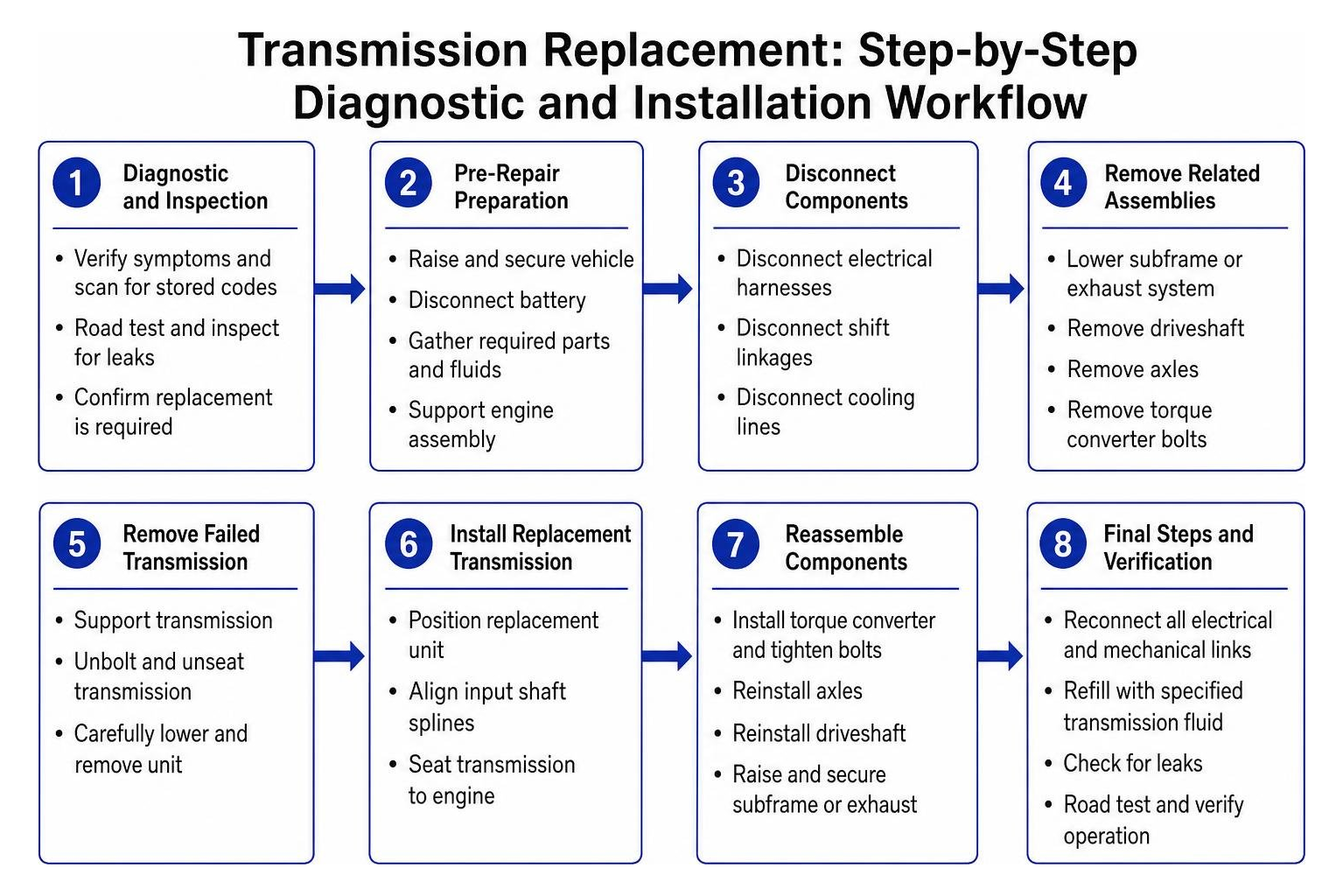
The labor complexity involves far more than unbolting a case. Technicians must:
Safely disconnect electrical harnesses, shift linkages, and cooling lines.
Support the engine assembly and lower the vehicle subframe or exhaust system.
Remove the driveshaft, axles, and torque converter mounting hardware.
Unseat the failed unit, seat the replacement, and align the input shaft splines without damaging the front pump seal.
Reassemble the drivetrain, fill with specialized fluid, run thermal adaptation cycles, and complete electronic coding.
Replacement Options: New, Remanufactured, Rebuilt, and Used
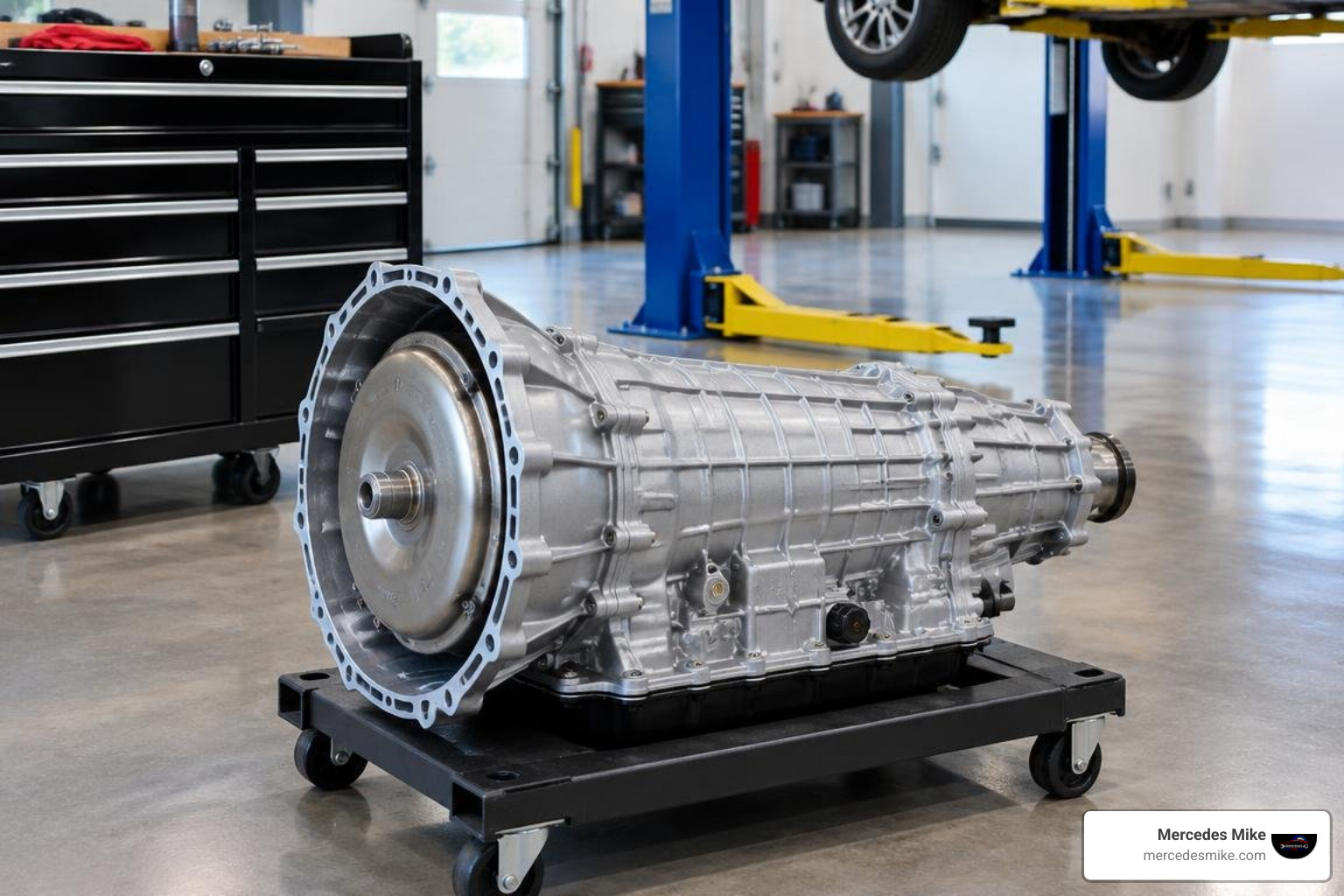
Choosing the best replacement path requires matching your vehicle's expected lifespan with your budget. Our transmission replacement guide explains that spending $7,000 for a crate OEM transmission on a vehicle worth $4,500 rarely makes financial sense unless the car possesses rare classic value or sentimental attachment.
A shop rebuild involves a technician tearing down your existing transmission, cleaning the hard metal casing, and replacing all "soft" friction materials—such as clutch packs, bands, gaskets, and O-rings. If the internal hard parts, like planetary gearsets and the valve body, are undamaged, a rebuild is highly cost-effective. For specialized European sports cars requiring precision tolerances, an experienced Porsche transmission rebuild can save thousands over purchasing a brand-new factory gearbox from Germany.
How Transmission Types Impact the Cost to Replace Car Transmission
The internal architecture of your transmission dictates the replacement complexity and final cost:
Manual Transmissions ($1,500 to $3,500 installed): Featuring simple mechanical gearsets and fewer moving parts, manual gearboxes are the most economical to replace or rebuild. The job often includes a new clutch disc, pressure plate, and throwout bearing.
Traditional Automatic Transmissions ($2,500 to $5,500 installed): Modern 6-speed to 10-speed automatics use hydraulic planetary gearsets, internal solenoids, and a torque converter. Reviewing standard automatic transmission replacement cost metrics shows that added gear ratios increase both internal parts costs and labor hours.
Continuously Variable Transmissions / CVTs ($3,500 to $7,000 installed): CVTs rely on high-tension steel belts and variable-width pulleys. Because internal components suffer heavy friction wear and many manufacturers do not supply individual internal replacement parts, CVTs almost always require complete unit replacement rather than rebuilding.
Dual-Clutch Transmissions / DCTs ($4,500 to $8,500+ installed): Common in high-performance German cars, DCTs utilize twin wet or dry clutches operated by mechatronic computer modules. Rebuilding or replacing them requires specialized diagnostic computers, precision calibration software, and expensive proprietary fluids.
Additional Parts and Hidden Line Items
When budgeting for a transmission replacement, look closely at the itemized quote. A complete, professional job requires supporting components that prevent the replacement unit from failing prematurely:
Torque Converter Replacement ($350 – $1,000): When an automatic transmission fails, metal shavings circulate directly into the torque converter. Installing a new unit is essential, as the cost to fix torque converter damage later will require repeating the entire labor process.
Transmission Cooler Line Flush ($150 – $250): Debris trapped in the transmission cooler lines must be power-flushed out to avoid contaminating the fresh transmission.
Transmission Control Module (TCM) Programming ($150 – $350): Modern transmissions require vehicle-specific VIN coding and clutch adaptation relearning using dealer-level diagnostic scanners.
Axle Seals, Input Shaft Seals, and Gaskets ($50 – $150): Replacing dry, brittle rubber seals prevents immediate fluid leaks.
Transmission Fluid and Filter ($150 – $300): High-grade synthetic and European-spec fluids are critical for thermal stability and hydraulic pressure.
Transmission Mounts ($100 – $300): Worn rubber engine and transmission mounts cause driveline vibration and should be replaced while the subframe is lowered.
Repair vs. Replace: The 50 Percent Vehicle Value Rule

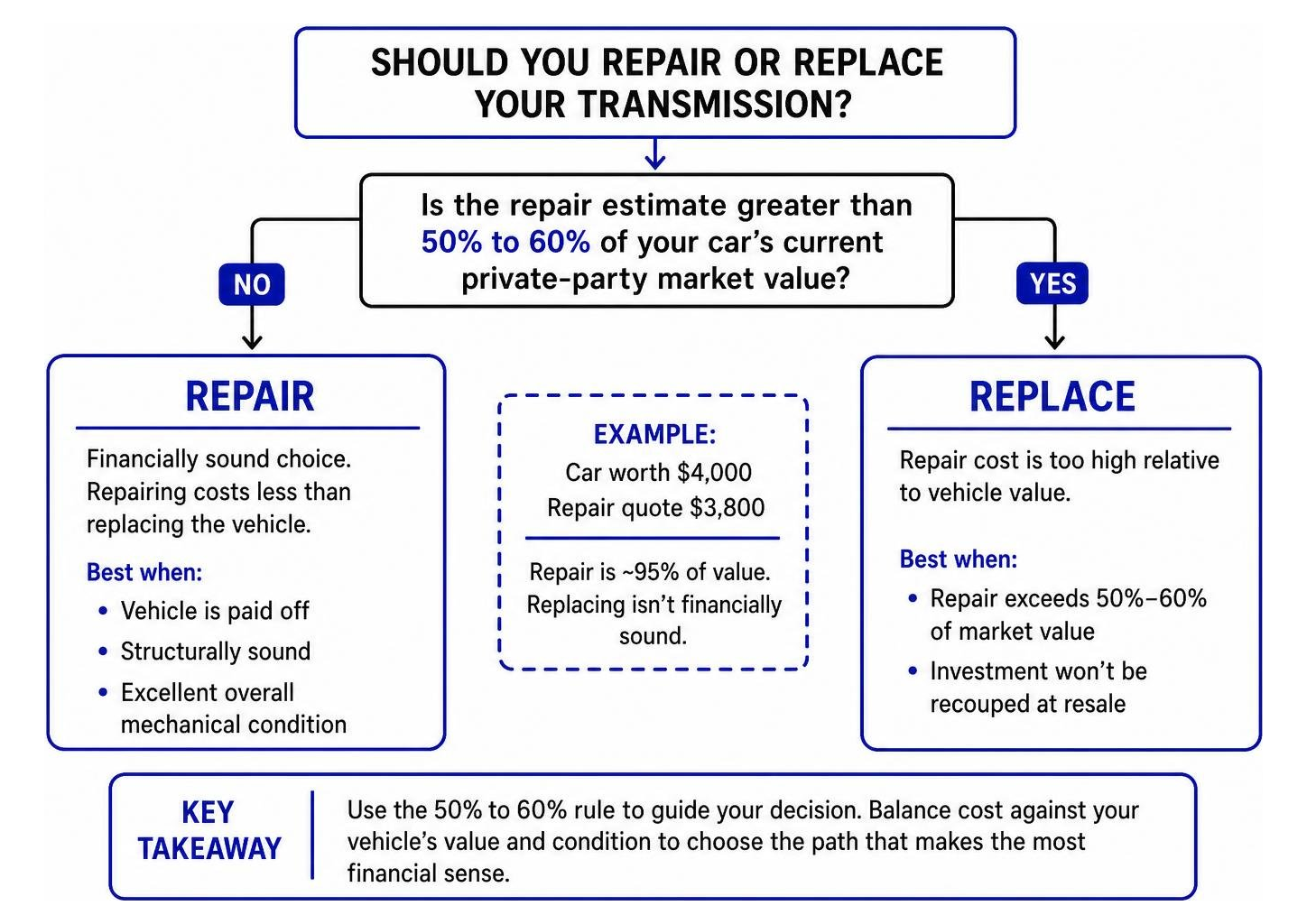
Facing a major driveline estimate leads to a crucial financial question: should you fix the car or replace the entire vehicle? A reliable standard used by automotive professionals is the 50 Percent Vehicle Value Rule.
If a transmission repair quote exceeds 50% to 60% of the car's current private-party market value, replacing the transmission may not be financially sound. For example, if your 2012 sedan is worth $4,000 on the open market and needs a $3,800 remanufactured transmission swap, spending that money leaves you with a car that is still only worth $4,000. You rarely recoup transmission replacement costs upon resale.
However, if the vehicle is fully paid off, structurally sound, and in excellent overall mechanical condition, spending $3,500 to gain another 3 to 5 years of reliable driving is far cheaper than taking on $25,000 in financing for a newer vehicle. When assessing options, evaluating how much to repair Mercedes transmission assemblies against your vehicle's residual value will help clarify the right path.
Critical Warning Signs of Imminent Failure
Ignoring minor transmission symptoms turns small, manageable fixes into catastrophic failures. If you experience any of the following critical warning signs, shut down the vehicle and seek professional diagnostics immediately:
Severe Gear Slipping: The engine revs freely (RPMs shoot up), but the vehicle struggles to accelerate or loses forward momentum entirely.
Burnt, Dark Transmission Fluid: Healthy fluid is bright pink or translucent red. If your fluid appears dark brown or black and smells like burnt toast, internal friction clutches are disintegrating.
Heavy Metal Grinding or Whining: Loud mechanical whining, humming, or metal-on-metal grinding in gear indicates failing internal bearings or stripped planetary gears.
Delayed Forward or Reverse Engagement: Shifting the lever into Drive or Reverse results in a 2- to 5-second delay followed by a violent thud or jerk.
Emergency Limp-Home Mode: The vehicle's computer locks the gearbox into 2nd or 3rd gear to protect the internal mechanicals from tearing themselves apart.
When Minor Repairs Save Your Gearbox
Not every transmission malfunction requires ripping the entire gearbox out of the chassis. Many modern transmission failures stem from external or serviceable electronic components that can be repaired for a fraction of the cost.
Common spot repairs include:
Shift Solenoid Replacement ($300 – $800): Solenoids regulate hydraulic fluid flow to engage specific gear sets. A dedicated BMW transmission solenoid replacement can restore crisp, seamless shifting without touching the mechanical gearsets.
Valve Body / Mechatronic Unit Repair ($800 – $1,800): The hydraulic "brain" of the transmission can develop sticking valves or cracked circuit boards. Replacing the valve body alone saves thousands compared to full unit replacement.
External Fluid Leaks ($200 – $600): Replacing a leaking transmission pan gasket, cooler line O-ring, or output shaft seal stops fluid loss before low line pressure burns out internal clutches.
Routine Fluid and Filter Exchanges ($150 – $350): Following a strict Mercedes transmission care guide with regular fluid services prevents sludge buildup, stabilizes operating temperatures, and extends gearbox lifespan past 150,000 miles.
Frequently Asked Questions about Transmission Replacement
Does auto insurance or warranty cover transmission replacement?
Standard comprehensive and collision auto insurance policies do not cover mechanical breakdown, wear and tear, or transmission failure. Insurance only covers transmission damage if it results directly from an external insured incident, such as a road collision, flood submersion, vandalism, or an impact with road debris that cracks the transmission casing.
If your vehicle is relatively new, the factory powertrain warranty (typically 5 years / 60,000 miles, or up to 10 years / 100,000 miles on select makes) covers internal mechanical defects. Aftermarket extended service contracts also cover internal lubricated transmission parts, provided you can present documentation proving you adhered to the manufacturer's scheduled fluid maintenance intervals.
How long does a transmission replacement take?
The physical labor required to replace a transmission takes between 1 and 2 full business days (6 to 16 labor hours). However, the total calendar turnaround time at a repair facility usually spans 3 to 7 business days.
Turnaround delays are usually caused by:
Parts Sourcing and Freight: Sourcing a verified remanufactured or specialty European transmission unit takes 2 to 4 business days for delivery.
Supplemental Teardown Inspection: Checking related components like flexplates, motor mounts, and driveshafts for secondary wear.
Software Configuration: Downloading and flashing factory vehicle adaptation files and completing extensive road-testing cycles.
Can driving with slipping gears destroy the whole transmission?
Yes. Driving on a slipping transmission is the quickest way to turn an inexpensive repair into a mandatory replacement. When a transmission slips, internal clutch packs fail to lock together firmly, creating intense thermal friction.
This extreme heat quickly cooks the remaining transmission fluid, destroys internal rubber seals, and releases microscopic metallic and carbon debris throughout the hydraulic channels. Within just a few miles of slipping, debris enters the torque converter and valve body, causing total internal mechanical destruction.
Conclusion
Facing a transmission replacement is one of the most substantial automotive repair decisions you will encounter. By taking the time to evaluate the unit type, understanding the breakdown of parts versus labor, and applying the 50 Percent Rule against your car's market value, you can make a financially responsible choice.
Always demand a fully itemized written estimate that covers programming, fluids, cooler flushing, and torque converter replacement before authorizing any teardown. If your car is showing warning signs of shifting trouble, early intervention is key. For drivers in Pompano Beach, Deerfield Beach, and throughout South Florida, scheduling an inspection with our certified technicians for professional European auto services ensures you receive an accurate diagnosis and honest repair recommendations backed by decades of hands-on experience.