German Auto AC Flush Guide for Longevity and Performance
Why a German Auto AC System Flush Is Critical After Component Failure
When a compressor seizes or sheds internal material on a Mercedes-Benz, BMW, Audi, Porsche, or Volkswagen, it does not fail quietly. The mechanical breakdown generates micro-fine metal shavings, aluminum glitter, burnt lubricant known as "black death" sludge, and shattered desiccant beads from the drier. These contaminants quickly circulate through the entire high-pressure and low-pressure plumbing.
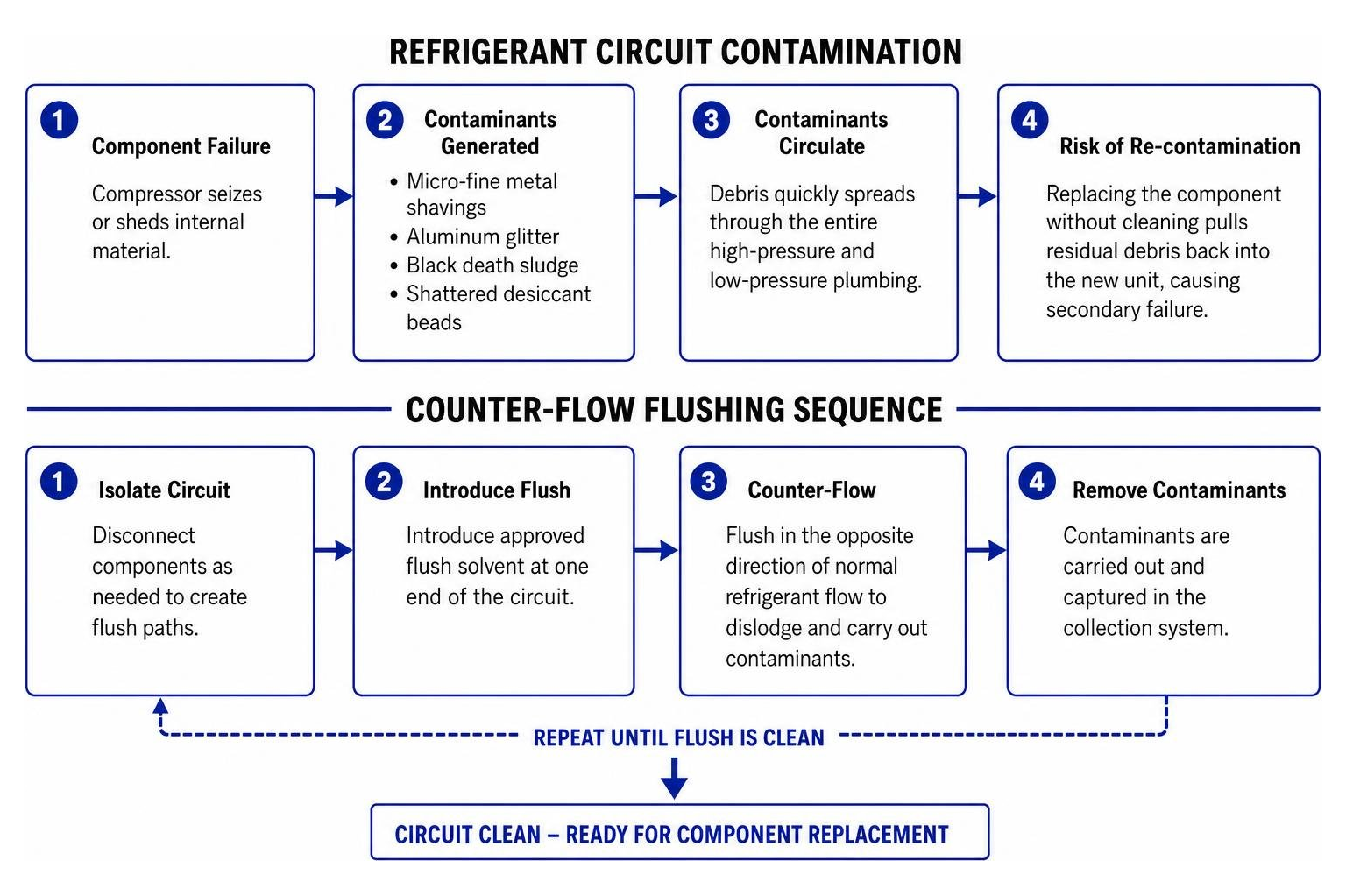
Simply replacing the broken pump without cleaning the lines leads to immediate re-contamination. The newly installed unit pulls residual debris right back into its precision pistons or swashplate assembly, causing secondary failure within days or weeks. When calculating the overall cost to fix AC compressor failures, omitting the cleaning stage turns an investment into an expensive repeat repair.
Comprehensive AC repair on German vehicles always isolates the cause and completely purges the circuit.
Service Characteristic | Standard Refrigerant Recharge | Dedicated AC System Flush |
|---|---|---|
Primary Objective | Restore lost refrigerant mass | Remove particulate debris, moisture, and degraded oil |
Circuit State | Closed loop, components connected | Open loop, restricted components bypassed/removed |
Fluid Movement | Normal unidirectional vapor/liquid cycle | High-velocity reverse (counter-flow) cleaning cycle |
Debris Extraction | None (trapped at expansion valves/condenser) | Complete extraction into external filtration station |
Oil Management | Adds small balancing charge | Strips 100% of old oil for precise OEM dry baseline refill |
Warranty Requirement | Insufficient for catastrophic failure claims | Mandatory by German OEMs to validate new compressor warranty |
Debris Dispersion in Modern German HVAC Circuits
Modern European climate control systems use tightly engineered, high-efficiency components. Micro-channel condensers and parallel-flow evaporators feature microscopic extrusion passages that maximize thermal transfer. Unfortunately, these tiny passageways also act as physical strainers for metallic grit.
Furthermore, variable displacement compressors rely on delicate internal electronic control valves (ECVs). These valves adjust displacement using minuscule orifices that can clog from a single fleck of sheared aluminum. When contaminated oil pools in low-lying plumbing bends and line mufflers, normal refrigerant flow pushes that slurry directly into new components.
Protecting Replacement Parts and Factory Warranties
German auto manufacturers mandate documented circuit flushing whenever a compressor, receiver-drier, or expansion device suffers catastrophic failure. Performing a standard air conditioning recharge without flushing voids parts warranties from major suppliers and factory programs.
Factory service bulletins—such as Volkswagen Group's Technical Service Bulletin (TSB) 2049039—require service facilities to attach physical diagnostic and flush printouts from approved service stations directly to the repair order to validate warranty coverage.
Step-by-Step Guide: How to Perform an AC System Flush on German Vehicles
Executing an OEM-grade flush requires strict technical discipline, dedicated equipment, and safety awareness. On modern mild-hybrid and plug-in hybrid platforms (such as 48V Mercedes EQ-Boost or Audi TFSI e models), technicians must fully de-energize the high-voltage system and confirm zero potential before disconnecting compressor electrical harnesses or service valves.
Essential Tools and VAS Adapter Setup for German Auto AC System Flush
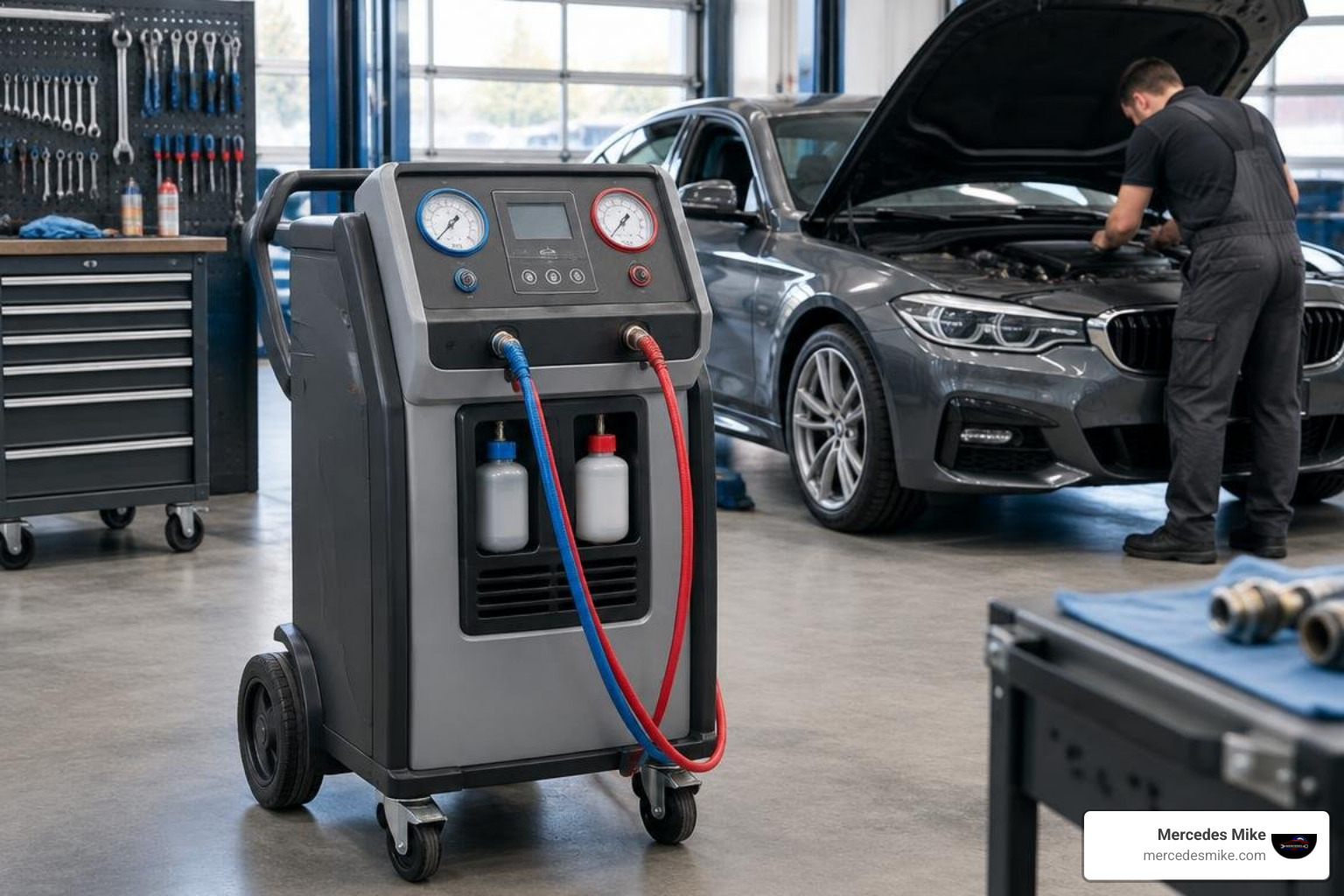
A factory-level German auto AC system flush cannot be achieved with basic aerosol flush cans or universal rubber cones. Doing the job right requires dedicated service units such as the Robinair ROB134APF system for R134a networks or the MAHLE VAS581005 unit paired with the RTI360831040 flush apparatus for newer platforms.
Technicians rely on specialized adapter sets to connect directly to factory line fittings:
VAS 6338/1 Adapter Set: The foundational master bridging kit for standard German expansion blocks and compressor ports.
VAS 6338/38 Adapter: Tailored connection blocks for modern Audi and Volkswagen longitudinal chassis configurations.
VAS 6338/63 Kit: High-pressure line adapters built specifically for large-chassis German platforms.
Manufacturer guidance outlined in TSB 87-18-08 R1234yf Cleaning Guidelines mandates using these exact adapters to prevent fitting deformation and maintain an airtight circuit during high-pressure cycles. Continuous sight-glass monitoring allows our technicians to inspect solvent clarity and oil extraction in real time.
Component Bypass and Removal Protocols
Certain climate control parts cannot be flushed due to internal check valves, variable metering orifices, or porous filtration media:
Compressor Removal: Disconnect and remove the failed compressor. Install rigid bypass bridges (from the VAS 6338 kit) across the suction and discharge lines.
Expansion Valve / Orifice Tube Extraction: Remove the thermostatic expansion valve (TXV). Flushing through an expansion valve is impossible because its tiny metering slit blocks both fluid velocity and dislodged particles. Install an expansion valve bypass plate.
Receiver-Drier / Desiccant Cartridge Extraction: Remove and discard the desiccant bag or filter cartridge from the condenser tank. If the receiver-drier is integrated permanently into a micro-channel condenser and cannot be removed, the entire condenser assembly must be replaced after flushing the rest of the lines.
Leak Isolation: Before fluid circulation, address any structural breach using standard refrigerant leak repair practices to ensure the closed circuit holds maximum vacuum during cleaning cycles.
Executing the Multi-Cycle Reverse Flush Procedure
With bypass plates secured and the service station connected:
Evacuation and Rise Test: The station pulls a preliminary deep vacuum and performs a mandatory pressure-rise test to ensure zero ambient leaks.
Extended Three-Cycle Counter-Flow Flush: The machine pumps liquid refrigerant or approved solvent through the lines in reverse—opposite to normal refrigerant flow. This backward velocity lifts debris lodged behind internal line shoulders and fittings.
Soak and Vapor Extraction: The station alternates between liquid rinsing and high-vacuum recovery cycles, dissolving varnished oil films and extracting suspended grit into external machine filters.
Clarity Verification: Technicians inspect the diagnostic sight glass. The fluid must run completely clear and colorless. Factory procedures documented in the Audi R134a Refrigerant Circuit Cleaning Manual specify running additional cleaning cycles if discolored oil or particulate remains visible.
Reassembly: Install a brand-new OEM expansion valve, fresh receiver-drier cartridge, and the replacement compressor with its exact factory oil pre-charge.
Multi-Zone and Rear Climate Control Circuits
Full-size German SUVs—such as the Volkswagen Atlas, Touareg, Porsche Cayenne, BMW X7, and Mercedes-Benz GLS—feature dual-evaporator, multi-zone architectures. These platforms run long underbody aluminum lines back to a separate rear climate core.
Never flush the front and rear systems as a single open loop. The extensive line volume drops solvent velocity, allowing dislodged shavings to settle inside underbody pipes. Instead, isolate the front evaporator and rear auxiliary unit into two separate circuits:
Connect the front loop using standard expansion bypass blocks.
On vehicles like the Volkswagen Atlas, access the rear underbody line joint, temporarily remove the internal high-pressure line dowel pin if needed, and install the VAS 6338/60 rear adapter set.
Flush the rear circuit independently in both directions before reinstalling the dowel pin, fitting a new rear expansion valve, and joining the networks for final evacuation.
Refrigerant Generations, Regulatory Standards, and Economic Factors
Climate service on German automobiles requires understanding how refrigerant chemistry and international trade rules affect maintenance requirements. Whether servicing an older classic or referencing a modern BMW air conditioning recharge guide 2026, correct fluid identification is critical.
Parameter / Requirement | R134a Systems (1998–2017) | R1234yf Systems (2018–Present) |
|---|---|---|
Global Warming Potential (GWP) | 1,430 | < 1 |
ASHRAE Safety Classification | A1 (Non-flammable) | A2L (Mildly flammable) |
Dedicated Service Machine | Robinair ROB134APF or equivalent | MAHLE VAS581005 / SAE J2843 unit |
Minimum Station Internal Mass | 7.0 kg (15.4 lbs) liquid reserve | Certified internal tank reserve + identifier |
Station Maintenance Filter Unit | Behr / Bosch spin-on filters | RTI360831040 coalescing filter kit |
OEM Flush Labor Unit Allocation | 110–140 TU (Front), 310 TU (Multi-zone) | 110–140 TU (Front), 310 TU (Multi-zone) |
Refrigerant Standards: 1998–2017 R134a vs. 2018+ R1234yf Systems
European environmental directives phased out tetrafluoroethane (R134a) due to its high Global Warming Potential (GWP of 1,430), replacing it with hydrofluoroolefin R1234yf (GWP less than 1). Because R1234yf is classified as an A2L mildly flammable gas, service machines use anti-arcing internal switches, mandatory recovery identifiers, and calibrated flow meters.
When cleaning R134a systems, the station's internal supply tank must contain at least 7 kg of pure refrigerant to maintain proper solvent mass during high-speed circulation. For R1234yf platforms, procedures detailed in the V871801 Cleaning Refrigerant Circuit Technical Bulletin require specialized coalescing filters. These filters capture micro-debris without letting volatile hydrocarbons vent into the shop environment.
Labor Units, Warranty Claims, and Regulatory Transparency
In German technical flat-rate systems, labor is calculated in Time Units (TU), where 100 TU equals one standard hour:
Front-only AC circuit cleaning typically allocates 110 to 140 TU (1.1 to 1.4 hours).
Multi-zone platforms (such as four-zone Touareg, Cayenne, or Atlas configurations) require up to 310 TU (3.1 hours) due to rear interior panel removal and auxiliary line isolation.
Factory warranty policies often provide an allowance (such as a standard $8.50 warranty credit) to offset a portion of consumable filter kit costs during required service procedures.
Modern consumer protection laws, including the Federal Trade Commission (FTC) CARS Rule, require clear upfront disclosures and itemized quotes for major automotive repairs. The CARS Rule is projected to save consumers nationwide more than $3.4 billion and an estimated 72 million hours annually by eliminating deceptive pricing and unauthorized add-on charges.
Shifting global trade terms and automotive tariffs also influence parts logistics. From April 2025 through March 2026, U.S. vehicle exports to Canada fell by roughly 22% (dropping from approximately $25.9 billion to $20.3 billion), while Canadian automotive imports from other nations grew by $2.85 billion—with Mexican production representing almost $2 billion of that shift. These trade adjustments highlight why professional facilities maintain direct OEM parts pipelines, helping car owners accurately forecast the cost of AC maintenance while sourcing genuine expansion valves, desiccant cartridges, and condensers without unexpected delays.
Modern Infotainment Diagnostics: Android Auto and Gemini Integration
In-cabin electronics now play an active role in automotive climate management. Current in-vehicle systems integrating Android Auto with Google Gemini conversational AI allow drivers to track minor performance changes before mechanical components fail.
Through real-time telemetry bridging, drivers can use voice prompts to query cabin cooling efficiency, identify unusual vent temperature deltas, or flag early HVAC fault codes. Catching high evaporator pressure warnings or irregular compressor cycling early helps motorists schedule timely AC unit maintenance before an electronic control valve seizes and contaminates the entire refrigerant circuit.
Frequently Asked Questions About German Car AC Maintenance
When is a German auto AC system flush required?
A full refrigerant circuit flush is mandatory whenever:
The AC compressor has suffered internal mechanical seizure or bearing failure.
The refrigerant system has remained open to ambient air following a collision or cracked line, introducing moisture that acidifies internal lubricant.
Burnt, blackened PAG or POE oil is discovered during basic diagnostic testing.
Reviewing our comprehensive AC repair cost guide 2026 can help you budget accurately for complete diagnostic cleanouts versus isolated component repairs.
Can chemical stop-leak additives be removed with an AC flush?
No. Chemical stop-leak sealants react with air and ambient moisture to form solid polymer deposits at leak sites. Once these additives circulate, they crystallize inside condenser micro-channels and evaporator cores.
Standard liquid flushes cannot dissolve cured stop-leak compounds. If sealants have contaminated the system, the condenser, expansion valve, lines, and evaporator must often be completely replaced. If airflow or vent balance is compromised by physical blockage, consult our AC vent repair complete guide 2026 to diagnose downstream distribution issues.
Can universal aftermarket solvent kits flush German AC systems?
Universal solvent canisters sold at consumer retail outlets should never be used on modern German climate circuits. These aggressive chemical solvents strip line coatings, degrade internal rubber O-rings, and leave harsh solvent residues that dilute the fresh PAG/POE compressor oil charge.
Furthermore, standard aerosol cans lack the pressure and volume needed to clear parallel-flow condensers. Professional German vehicle service requires closed-loop recovery stations utilizing pure, dedicated refrigerant flush modes or OEM-approved cleaning apparatuses, followed by a proper German auto AC recharge to exact gram specifications.
Conclusion
Precision engineering requires precision service. When your climate control system suffers a compressor failure, simply replacing the broken part and adding refrigerant invites premature failure. Performing a certified reverse-flow flush extracts microscopic metal debris, removes acidic oil, and safeguards your new components for years of reliable operation.
At Mercedes Mike, our technicians bring decades of hands-on experience and factory-grade tooling to every repair across South Florida—including Pompano Beach and Deerfield Beach. Located at 882 NE 41st Court off N Dixie Hwy, we handle every detail from routine maintenance to full climate system restorations. If your air conditioning is losing cooling power or you need dedicated Mercedes air conditioning service, contact our team today or explore our expert AC condenser repair services to restore optimal comfort to your vehicle.