How Professional Mechanics Spot Hard-to-Find German Car AC Leaks
Why German Luxury Vehicles Require Specialized AC Diagnostics
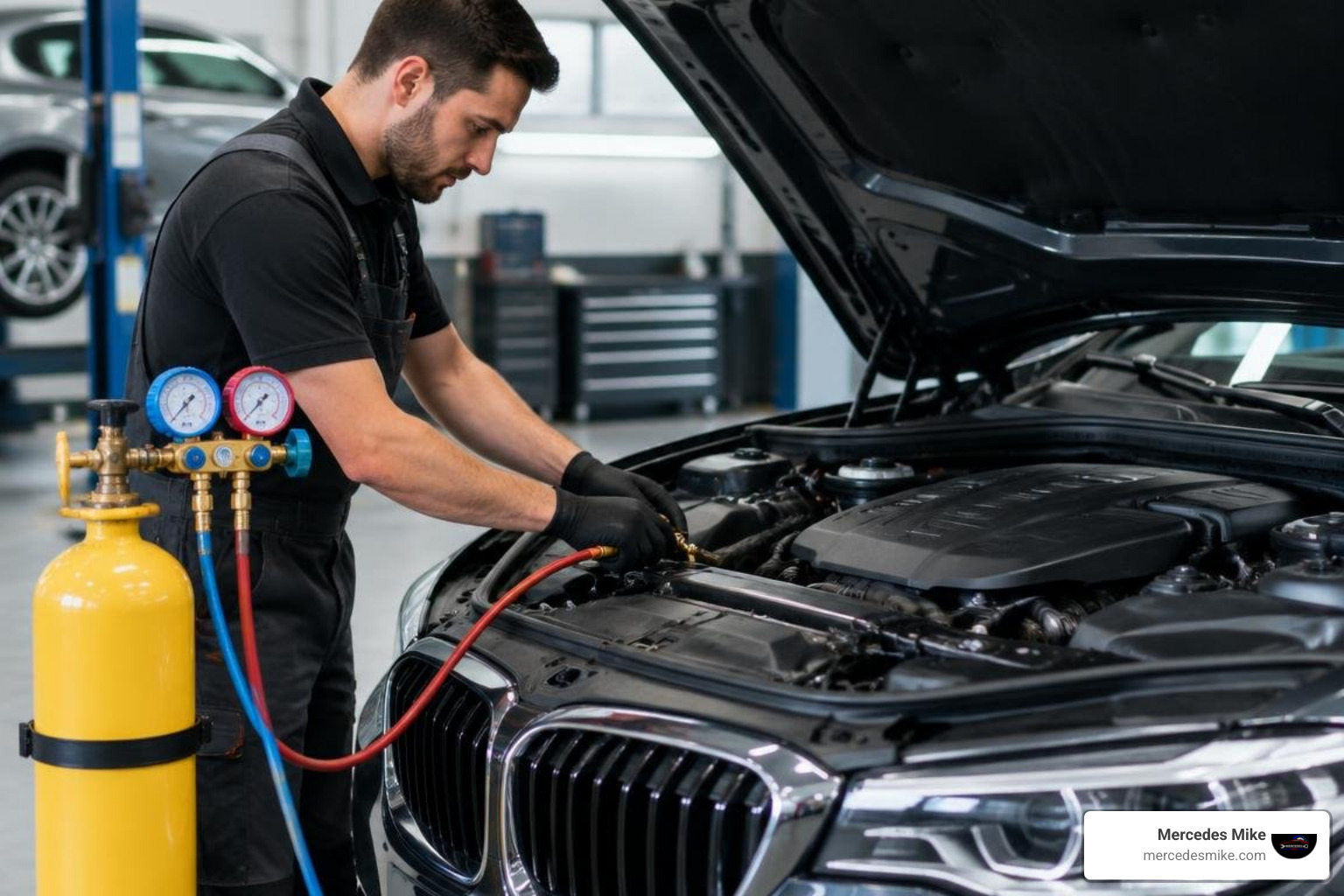
Professional mechanics spot hard-to-find German car AC leaks by first recovering the remaining refrigerant, then pressurizing the system with dry oxygen-free nitrogen and watching for pressure decay on digital gauges. When a drop is confirmed but the leak site is not visible, they switch to a 95% nitrogen and 5% hydrogen forming gas and sweep suspected lines, fittings, and the condensate drain with a hydrogen-selective electronic sniffer. This method finds microscopic pores that a basic vacuum hold test can miss.
German vehicle climate control systems are engineered to high performance standards. Whether your vehicle utilizes standard R134a systems or newer, environmentally compliant R1234yf refrigerants, these setups operate under tight manufacturing tolerances. Unlike simpler automotive platforms, German platforms often feature dual-zone or quad-zone climate loops managed by intricate variable-displacement compressors.
Because these variable compressors adjust their displacement continuously rather than cycling on and off, even a slight loss of pressure forces the internal swash plate to work under strain. This causes accelerated wear and inadequate cabin cooling. Performing a standard air conditioning recharge without understanding these systems rarely solves the root issue. The high-pressure thresholds and electronic sensors in BMW, Mercedes-Benz, Audi, and Porsche models require precise diagnostic procedures to avoid misdiagnosing a mechanical failure when the real culprit is a microscopic leak.
Typical Refrigerant Lifespan vs. Warning Signs of a Leak
Under normal operating conditions, a factory-sealed German climate control loop experiences very minor, natural molecular permeation through flexible rubber barriers. Because of this, an AC charge should easily last 3 to 5 years.
If you notice rapid pressure loss or your car's vents blow ambient air just weeks or months after service, you have an active leak. Key warning signs include:
A faint hissing sound behind the center dashboard vents when the AC engages.
Oily residue collecting dirt around line connections or cooling fins.
Inconsistent cooling that works only at highway speeds.
The climate control system blowing warm air entirely.
When cooling performance drops noticeably within a single season, booking a proper German auto AC recharge paired with a targeted diagnostic test is the only reliable way to protect expensive internal parts.
Common Failure Points Across BMW, Mercedes-Benz, Audi, and Porsche
Every German marque features distinct engineering designs that lead to characteristic weak points over time:
Condensers: Positioned right behind the front grille, aluminum condenser tubes take the brunt of road debris. Tiny stone chips cause pinhole fractures that weep refrigerant and oil.
Compressor Shaft Seals: The radial shaft seal on the compressor experiences rotational friction, engine heat, and age-related hardening, allowing gas to escape past the front pulley.
Rubber-to-Metal Line Crimps: Engine vibration stresses the crimped joints where flexible rubber hoses meet rigid aluminum tubing.
Schrader Service Valves: The internal rubber seals inside the high-side and low-side service ports degrade, causing slow leaks hidden beneath plastic dust caps.
Thermal Expansion Valves (TXV): O-rings seating the expansion valve can flatten and crack over time.
Evaporator Cores: Buried deep inside the dashboard HVAC box, the evaporator core is vulnerable to corrosion from trapped condensation.
During an Audi Q5 AC repair or a Mercedes-Benz inspection, these common locations are the first areas our technicians check.
Advanced German Car AC Leak Detection Methods Used by Technicians
A simple vacuum hold test performed by an automated machine is rarely enough to find tricky leaks. A vacuum pulls components inward, which can temporarily pull a cracked rubber lip seal shut, showing a false pass. Once the system is pressurized, that same seal flexes outward and leaks.
To locate elusive leaks, professional workshops use specialized pressure equipment, electronic sniffers, and acoustic ultrasonic tools aligned with HELLA AC leak detection instructions and European workshop standards.
High-Pressure Nitrogen Testing Procedures and OEM Pressure Limits
Pressure testing with dry, oxygen-free nitrogen allows technicians to simulate real-world operating loads safely without venting costly or restricted refrigerant into the atmosphere. Nitrogen absorbs internal moisture and does not react with residual lubricant.
When conducting these tests, technicians must adhere strictly to manufacturer limits:
BMW: Specifies a maximum approved test pressure of 10 bar to protect sensitive internal components.
Volkswagen / Audi Group: Outlines a working maximum of 15 bar (218 psi) in their official Volkswagen technical bulletin on nitrogen diagnosis.
The diagnostic process follows a controlled sequence:
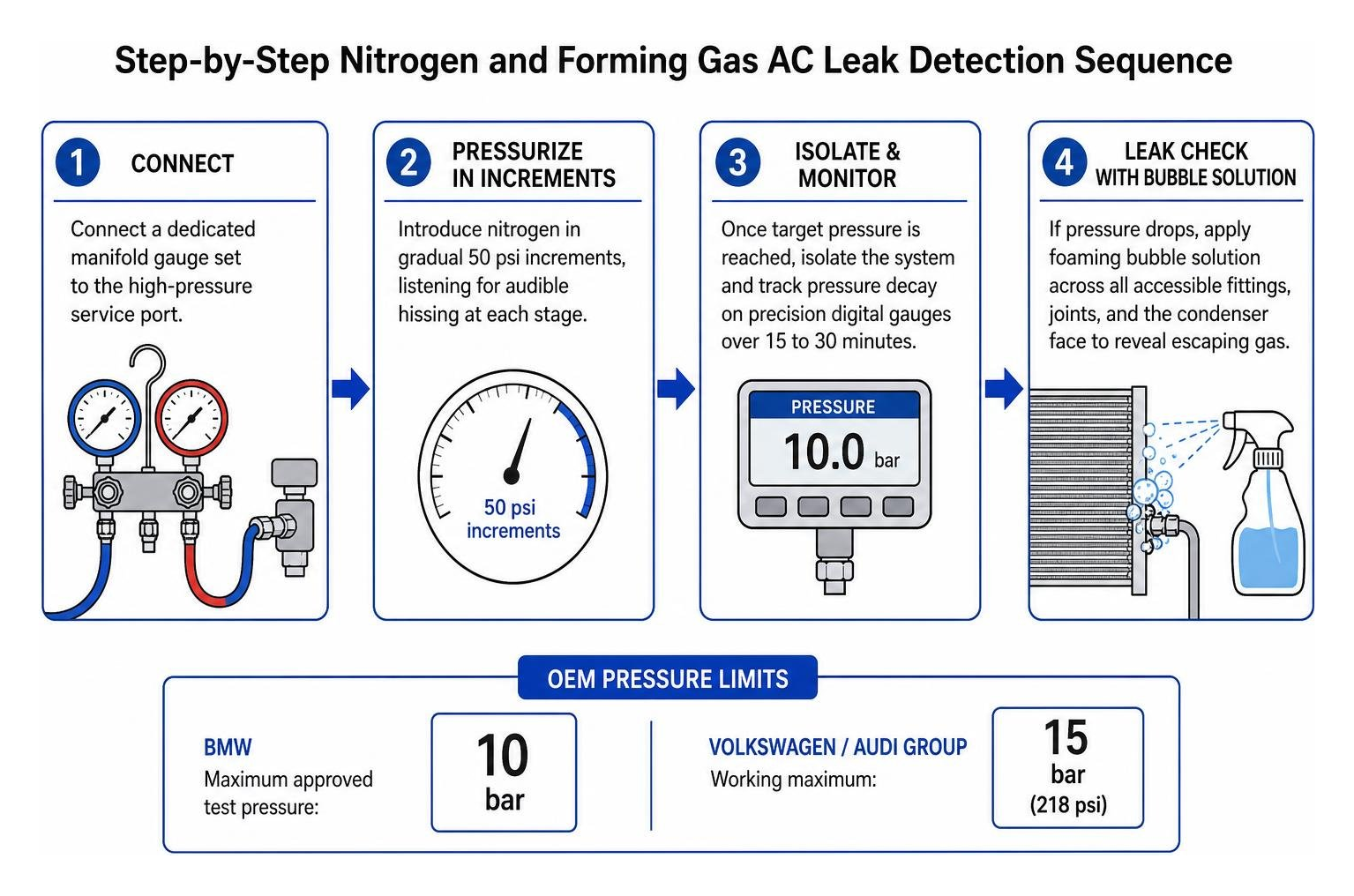
The technician connects a dedicated manifold gauge set to the vehicle's high-pressure service port.
Nitrogen is introduced in gradual 50 psi increments, allowing the technician to listen for audible hissing at each stage.
Once the target pressure is reached, the system is isolated, and pressure decay is tracked on precision digital gauges over 15 to 30 minutes.
If the pressure drops, a specialized foaming bubble solution is applied across all accessible fittings, joints, and the condenser face to reveal escaping gas.
Forming Gas and Hydrogen Sniffers for Micro-Leak Detection
When nitrogen pressure testing confirms a pressure drop but the leak cannot be seen or heard, forming gas provides an advanced diagnostic solution. Forming gas consists of a non-flammable tracer mixture of 95% nitrogen and 5% hydrogen.
Because hydrogen molecules are significantly smaller than refrigerant molecules, this gas escapes through microscopic fissures that hold standard pressure. Technicians follow strict guidelines, such as BMW 7 Series forming gas specifications, ensuring the diagnostic sweep is completed within the manufacturer-recommended 3-hour testing window before the light gas disperses.
Specialized electronic detectors, like the SelectH2, utilize hydrogen-selective sensors that do not trigger false alarms from engine oil, cleaning solvents, or residual refrigerant vapors. After a 50-second sensor warm-up phase, the technician guides the probe tip 1 mm to 5 mm above suspected lines at a steady speed of roughly 1 to 2 cm per second, monitoring real-time parts-per-million (PPM) concentration readouts.
UV Dye Inspection vs. Forming Gas: Pros, Cons, and EU Regulations
While fluorescent contrast additives remain a familiar method in automotive repair, evolving European engineering standards and environmental regulations have changed shop practices. Under EU Directive 2006/40/EC, forming gas has largely replaced traditional dye methods due to system cleanliness and sensitivity.
Feature / Metric | UV Dye Inspection | Forming Gas (95% N₂ / 5% H₂) |
|---|---|---|
Detection Principle | Fluorescent dye glows under black light | Hydrogen-selective electronic sniffer |
Sensitivity | Good for moderate to large leaks | Excellent for micro-leaks (<0.5 mm) |
System Cleanliness | Leaves permanent chemical residue in oil | Leaves zero chemical residue or contaminants |
Speed to Results | Requires running AC for up to 60 mins | Instantaneous digital PPM readout |
EU / OEM Stance | Restricted or discouraged by some German OEMs | Fully approved and recommended factory method |
Hidden Core Access | Difficult to see inside enclosed HVAC boxes | Detects gas exiting through condensate drains |
While UV dye is affordable and clearly highlights surface leaks on open condenser tubes, forming gas provides a cleaner and more sensitive solution for complex luxury vehicles.
How to Diagnose Hidden Evaporator and Compressor Leaks
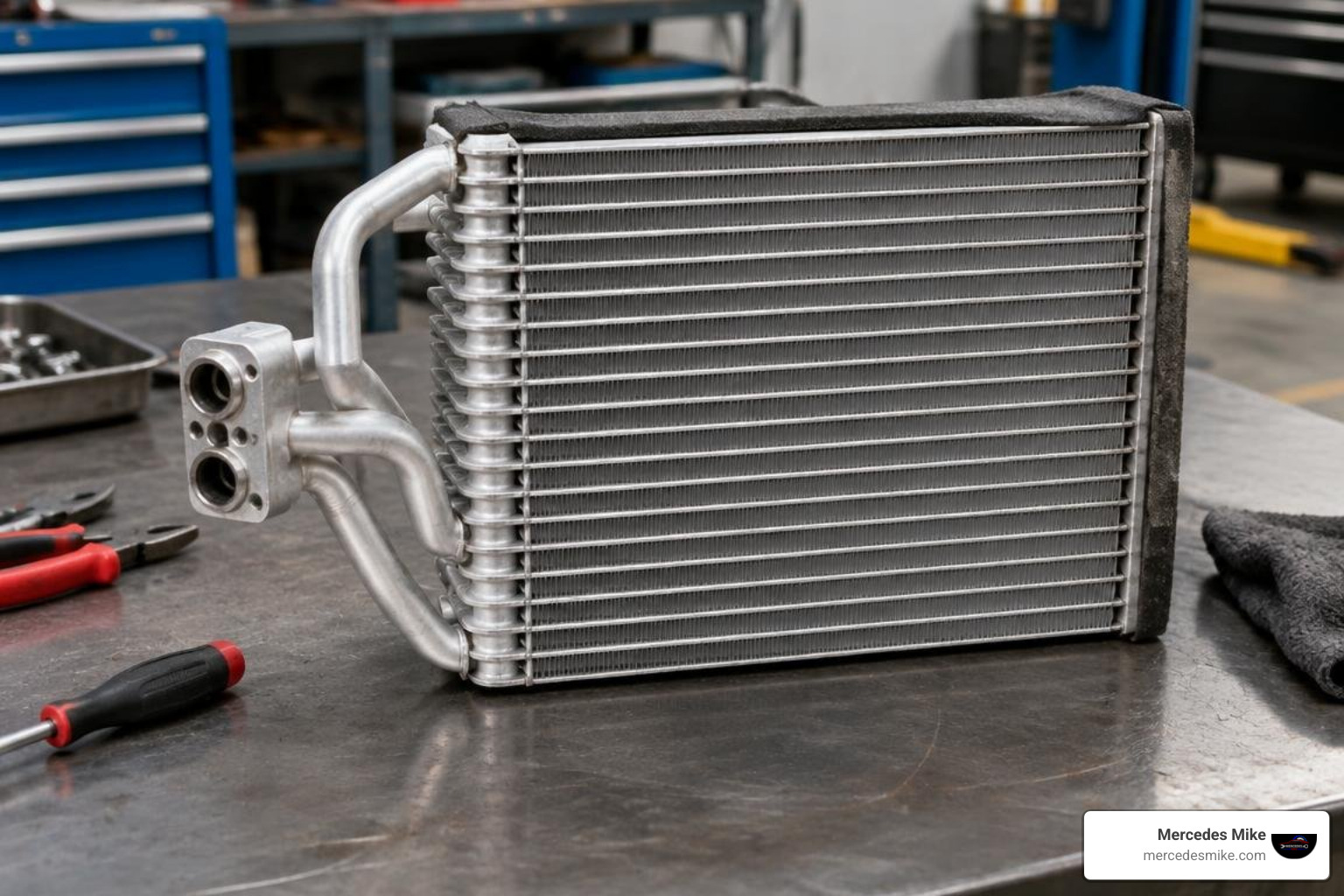
The most challenging leaks on German cars occur at the compressor shaft seal and the climate control evaporator core. Diagnosing an evaporator requires deep technical expertise because the component sits enclosed inside the dashboard HVAC distribution box.
Completing an evaporator refrigerant leak repair is labor-intensive, often demanding 12 to 15 hours of delicate labor to remove the steering column, center console, wiring harnesses, and dashboard structure. For example, replacing a leaking evaporator core on a classic Mercedes-Benz 300CE or a modern chassis is a major job. Similarly, evaluating the cost to fix AC compressor assemblies versus rebuilding front radial seals requires accurate upfront diagnosis.
Step-by-Step Evaporator Inspection in German Car AC Leak Detection
Because you cannot visually inspect the evaporator without taking the interior apart, technicians rely on systematic diagnostic steps:
Condensate Drain Analysis: When the evaporator leaks, refrigerant oil drips into the lower HVAC condensation tray. Technicians inspect the underbody AC drain tubes using an ultraviolet light to spot glowing oil traces or run a hydrogen sniffer probe directly up the drain tube opening.
Blower Motor and Cabin Filter Ports: Removing the cabin air filters and blower fan allows a flexible camera or electronic sniffer probe access to the air intake plenum directly adjacent to the core fins.
Chemical Scent Identification: A sweet, distinctly chemical odor blowing through the interior vents upon initial start-up is a classic symptom of an evaporator core leak.
Interior Vent Fogging: Pinhole vapor leaks can cause an oily, faint haze to coat the inside of the windshield when the defroster runs.
The Hidden Risks of Chemical Sealants and 'Seal Swellers'
When faced with an expensive evaporator or seal repair, vehicle owners are often tempted by off-the-shelf "stop-leak" cans or chemical seal expanders. While an inexpensive seal conditioner might temporarily swell a dry O-ring, chemical sealants carry serious mechanical risks.
These chemical agents work by reacting with air and ambient moisture to solidify into a gummy polymer. When injected into a modern system:
The sealant reacts with micro-moisture, crystallizing inside the tiny passages of the condenser, receiver drier, and thermal expansion valve.
Solidified sealants can permanently ruin dedicated professional AC recovery and recharging machines, resulting in steep cleanup or equipment replacement bills.
Major German vehicle manufacturers issue explicit service bulletins prohibiting chemical sealants, noting that their use voids component warranties.
If you drive a Mercedes-Benz, scheduling dedicated Mercedes air conditioning service to physically replace brittle O-rings with genuine OEM HNBR rubber is far safer and more reliable than risking total system blockage.
Cost Breakdown: Professional AC Leak Diagnosis and Repair in 2026
The cost of diagnosing and repairing an AC leak on a German car varies based on the vehicle's layout, the refrigerant type, and the failed part.
Service / Component Replacement | Typical Price Range (Labor & Parts) | Diagnostic / Labor Complexity |
|---|---|---|
Comprehensive Diagnostic Leak Test | $150 – $350 | Includes nitrogen pressure testing, sniffer sweep, and initial system evaluation |
Schrader Valve & O-Ring Replacement | $150 – $400 | Low complexity; includes evacuation, seal swap, vacuum hold, and full recharge |
AC Condenser Replacement | $650 – $1,400 | Moderate; requires front bumper cover removal and system recharge |
Compressor Assembly & Drier Replacement | $1,200 – $2,500 | High; includes belt removal, flush, compressor installation, and calibration |
Evaporator Core Replacement | $1,800 – $3,500+ | Very High; requires full dashboard removal and HVAC casing teardown |
For detailed breakdowns on component pricing, reference our comprehensive car AC repair cost guide 2026 and the specialized AC condenser repair cost guide.
DIY Limitations vs. Professional German Car AC Leak Detection
Attempting a DIY repair with generic auto-parts store recharge cans presents significant drawbacks for German luxury cars. Under EPA Section 609 guidelines, venting refrigerant into the atmosphere is illegal, and DIY cans lack the ability to safely recover old gas or pull the deep 29.9 inHg vacuum needed to boil off internal moisture before recharging.
Furthermore, DIY charging cans rely on simple low-side pressure gauges. Because modern variable-displacement compressors adjust their output dynamically, reading low-side pressure alone can lead to accidental overcharging. Overcharging risks blowing out compressor valves or blowing high-pressure safety burst discs. Factoring in the long-term cost of AC maintenance, professional diagnostic accuracy protects your investment and ensures your climate control system functions properly.
Frequently Asked Questions About German Car AC Leaks
How long should an AC recharge last in a German car?
A properly functioning AC system in a German vehicle should hold its charge and cool effectively for 3 to 5 years. While rubber hoses naturally allow a tiny amount of gas permeation over several years, any sudden loss of cooling or a system that requires yearly top-offs indicates an active leak. For more details on vehicle-specific schedules, consult our BMW air conditioning recharge guide 2026.
Why are chemical leak sealants bad for BMW, Audi, and Mercedes AC systems?
Chemical stop-leak additives contain moisture-activated polymers. When these chemicals circulate through the narrow micro-channels of German multi-flow condensers and thermal expansion valves, they can react and create solid blockages. This restricts refrigerant flow, causes compressor starvation, and damages commercial recovery equipment during future maintenance. When dealing with climate control faults, physical component replacement via standard AC repair is always the recommended path.
How do technicians test for leaks without releasing refrigerant into the atmosphere?
Certified technicians connect a dedicated recovery station to safely draw out any remaining refrigerant into an internal storage cylinder. Once the system is empty, it is pressurized with clean, dry oxygen-free nitrogen or a 95/5 forming gas mixture. Technicians then use acoustic ultrasonic listeners, digital pressure-decay gauges, and hydrogen electronic sniffers to pinpoint leaks safely and cleanly.
Get Factory-Grade AC Diagnostics at Mercedes Mike
A malfunctioning air conditioning system takes the enjoyment out of driving your luxury vehicle. At Mercedes Mike, our team specializes exclusively in precision maintenance and repairs for Mercedes-Benz, BMW, Audi, and Porsche vehicles.
Located in Pompano Beach, our certified technicians use factory-approved diagnostic tooling, nitrogen pressure stations, and electronic sniffers to find hard-to-spot leaks quickly and accurately. Whether your vehicle needs a quick O-ring replacement or a complete professional AC condenser repair, we ensure your climate control system is repaired correctly to factory standards. Contact us today to restore your car's ice-cold air.