Mercedes 7G-Tronic and 7G+ Service Intervals Explained Simply
Mercedes 7G-Tronic vs. 7G-Tronic Plus: Differences and Fluid Specs
For the standard Mercedes 7G-Tronic oil change interval, early 722.9 gearboxes should be serviced about every 39,000 miles or 4 years, while 7G-Tronic Plus models are best maintained every 40,000 to 50,000 miles or roughly 4 to 5 years. Understanding your transmission starts with recognizing the evolutionary jump between the early 722.9 (7G-Tronic) and the updated 7G-Tronic Plus (7G+). Introduced in the mid-2000s, the 722.9 was Mercedes-Benz’s flagship seven-speed automatic gearbox. Around 2010 to 2011, Mercedes introduced major internal updates alongside ECO start-stop technology, launching the 7G-Tronic Plus.
These two transmissions require completely different fluids, different oil pans, and different filtration designs. Putting the wrong parts or fluid into your gearbox will quickly lead to harsh shifting, clutch slippage, and internal wear.
Red ATF 134 vs. Blue ATF 134 FE Specifications
The most critical operational difference between the standard 7G-Tronic and the 7G-Tronic Plus is the automatic transmission fluid (ATF).
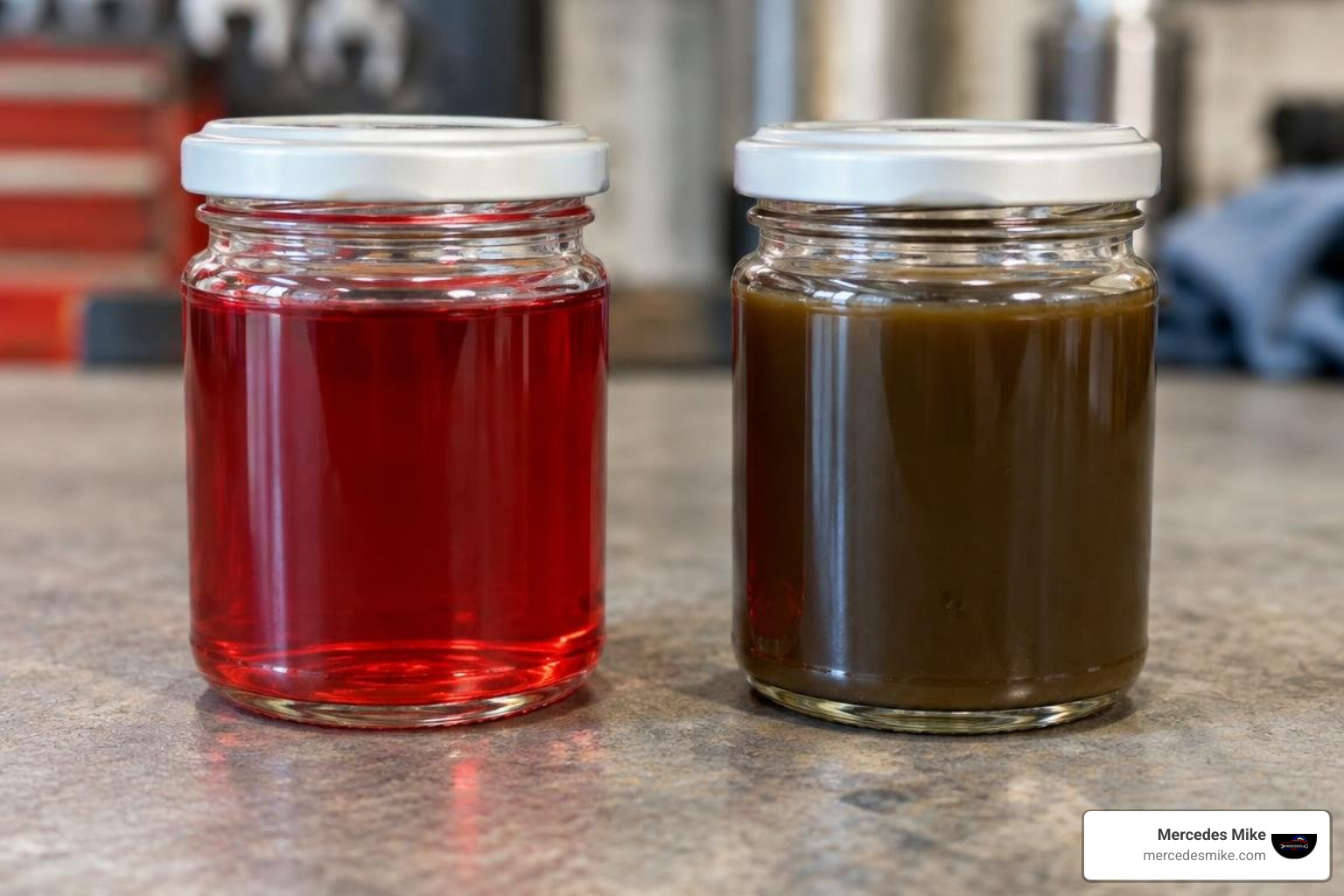
Early 7G-Tronic (Non-Plus): Uses MB 236.14 specification fluid, which is red in color (often known as ATF 134). This is a higher-viscosity fluid formulated for traditional hydraulic pressures.
7G-Tronic Plus: Uses MB 236.15 specification fluid, which is distinctively blue or blue-green (ATF 134 FE). This is an ultra-low-viscosity fluid designed to reduce friction and improve fuel economy.
Vehicles equipped with the 7G-Tronic Plus carry the Mercedes build option code A89. If your vehicle build data contains option code A89, it requires the blue MB 236.15 fluid.
These fluids are not backward compatible and must never be mixed. Adding red fluid to a 7G+ transmission increases hydrodynamic drag and causes shift timing errors. Conversely, putting low-viscosity blue fluid into an older 7G-Tronic leads to insufficient hydraulic pressure and accelerated clutch wear. Selecting the proper mercedes transmission fluid is essential for gearbox longevity.
Hardware Upgrades: Oil Pan and Filter Designs
Along with the revised fluid formulation, Mercedes redesigned the transmission pan and filtration system for the 7G-Tronic Plus.
The updated pan design features a deeper sump with specific indentations (often oval or dimpled) designed to accommodate a revised overflow standpipe and a substantially improved filter. The modern Filtran Smart Media filter uses a triple-layer synthetic media that captures abrasive particulate debris down to 50 microns—a major upgrade from the 80-micron single-layer filters used on early units.
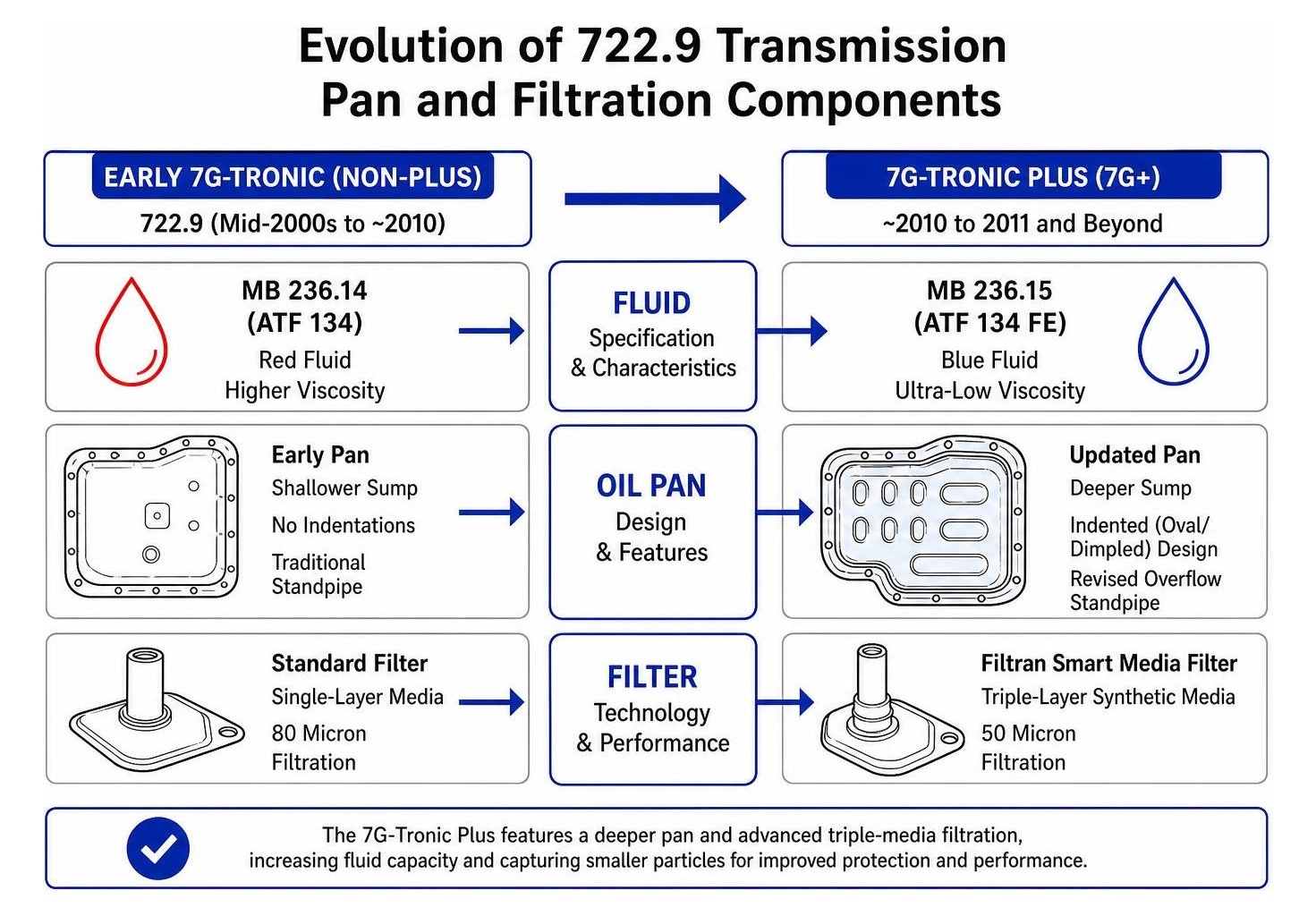
Many owners of earlier 7G-Tronic vehicles choose to retrofit the updated, deeper pan kit during their scheduled fluid flush. Upgrading the pan allows you to run the triple-media filter and increases overall fluid capacity, improving heat dissipation. To explore how different fluid grades and hardware setups interact across the entire drivetrain, check out our comprehensive mercedes gearbox oil overview.
Official vs. Real-World Mercedes 7G Tronic Oil Change Interval
Factory maintenance intervals provide a baseline, but real-world driving demands often require a more proactive approach to fluid care.
Standard Mercedes 7G Tronic Oil Change Interval by Model Year
Mercedes-Benz revised its service guidelines across several maintenance booklets. The early 722.9 gearboxes called for a single service at 39,000 miles (60,000 km) or 4 years, whereas the updated 7G-Tronic Plus extended this window.
Transmission Generation | Build Era | Factory Recommended Interval | Expert Recommended Interval | Fluid Specification | Fluid Color |
|---|---|---|---|---|---|
7G-Tronic (722.9) | ~2004–2010 | 39,000 miles (60,000 km) / 4 Years | 30,000–39,000 miles / 3–4 Years | MB 236.14 | Red |
7G-Tronic Plus (722.9+) | ~2011–2016+ | 77,500 miles (120,000 km) / 6–7 Years | 40,000–50,000 miles / 4–5 Years | MB 236.15 (Code A89) | Blue |
While official documentation like the MBUSA official maintenance manual details the extended schedules for later model years, our workshop experience shows that fluid breakdown begins long before 77,500 miles. Comparing these factory schedules against standard mercedes service schedule guidelines helps avoid unexpected downtime.
Why Driving Habits Shorten Your Mercedes 7G Tronic Oil Change Interval
Transmission fluid deteriorates primarily due to heat, shear forces, and particulate suspension. Modern automatic transmissions rely on microscopic friction modifiers suspended in the base oil. Over time, recurring thermal cycles break down these chemical additives.
Several real-world driving conditions accelerate this degradation:
Stop-and-go commuting: Constant cycling through lower gears builds excessive heat inside the torque converter and valve body.
Warm, humid climates: Operating in high ambient temperatures—such as daily driving in South Florida—places elevated thermal loads on cooling circuits.
Towing or heavy payloads: Increased torque loads shear the fluid's protective film between clutch plates.
When deciding on the right mercedes 7g tronic oil change interval, treating heavy city driving and warm climates as severe service ensures your transmission remains protected. For drivers encountering these operating conditions daily, sticking to a 40,000-mile or 4-year service interval prevents the friction material breakdown that leads to clunky shifts. You can review broader preventative strategies in our scheduled maintenance guide for Mercedes.
Complete 722.9 Service Requirements: Torque Converters & 4MATIC Systems
A comprehensive transmission service requires more than simply unbolting the drain plug and replacing what falls into the catch basin.
Why Draining the Torque Converter Is Critical
A standard pan-drain on a 722.9 gearbox removes only 4 to 5 liters of fluid—roughly 40% to 50% of the entire 9-liter system capacity. The remaining fluid stays trapped inside the torque converter, cooling lines, and valve body passages.
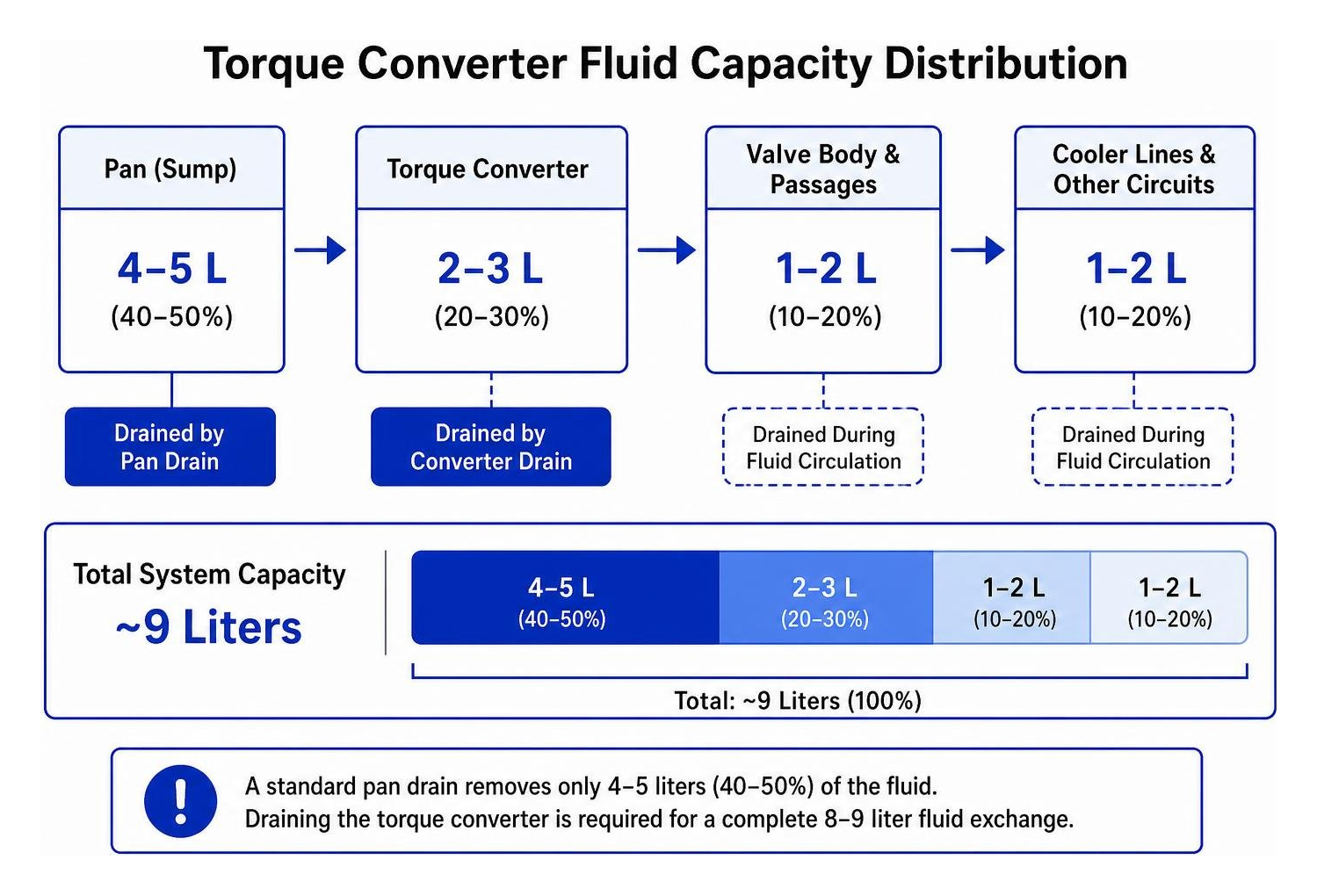
If you only drain the pan, you are diluting fresh, high-grade ATF with degraded fluid containing suspended contaminants. Most 722.9 transmissions have a dedicated torque converter drain plug accessible by manually rotating the engine crankshaft until the plug aligns with the bellhousing inspection port. Draining the torque converter allows for a full 8-to-9-liter fluid exchange. You can see this procedure highlighted in this video guide on 722.9 fluid replacement.
For detailed procedural guidelines on matching filter kits and factory service schedules, reference FCP Euro's 722.9 transmission recommendations and this practical step-by-step fluid and filter tutorial.
4MATIC Transfer Case Service and Leak Inspection
On Mercedes-Benz 4MATIC all-wheel-drive models, the transfer case is integrated directly onto the rear output section of the 722.9 transmission housing.
Because these units share internal fluid pathways or operate in close proximity, any leak at the rear output shaft seal compromises transmission fluid levels. During transmission maintenance, technicians must inspect:
Rear output flange seals for active weeping or fluid pooling.
Transfer case internal bearings for pitting or play caused by sheared oil.
Integrated differential seals for fluid cross-contamination.
Catching these leaks early preserves the transfer case drive gears and ensures the transmission remains at the correct operating pressure. For an in-depth review of drivetrain systems, consult our long-term mercedes transmission care guide 2026.
Consequences of Missed Services and Repair Risks
Neglecting fluid changes turns small maintenance items into complex, expensive mechanical repairs.
Symptoms of Degraded Transmission Fluid
When automatic transmission fluid breaks down, drivers usually notice several gradual symptoms:
Harsh 1-2 or 2-1 Downshifts: The valve body solenoids struggle to regulate pressure accurately through aged, low-viscosity fluid.
Delayed Gear Engagement: A noticeable pause when shifting from Park into Reverse or Drive.
RPM Fluctuation (Surging): The torque converter lockup clutch slips due to depleted friction modifiers.
Limp Mode (Transmission Stuck in Gear): The electronic conductor plate detects solenoid timing errors and locks the transmission in 2nd or 3rd gear as a failsafe.
Addressing these warning signs early with our essential mercedes maintenance tips 2026 can save you from a major overhaul.
Repairing vs. Maintaining Your 722.9 Transmission
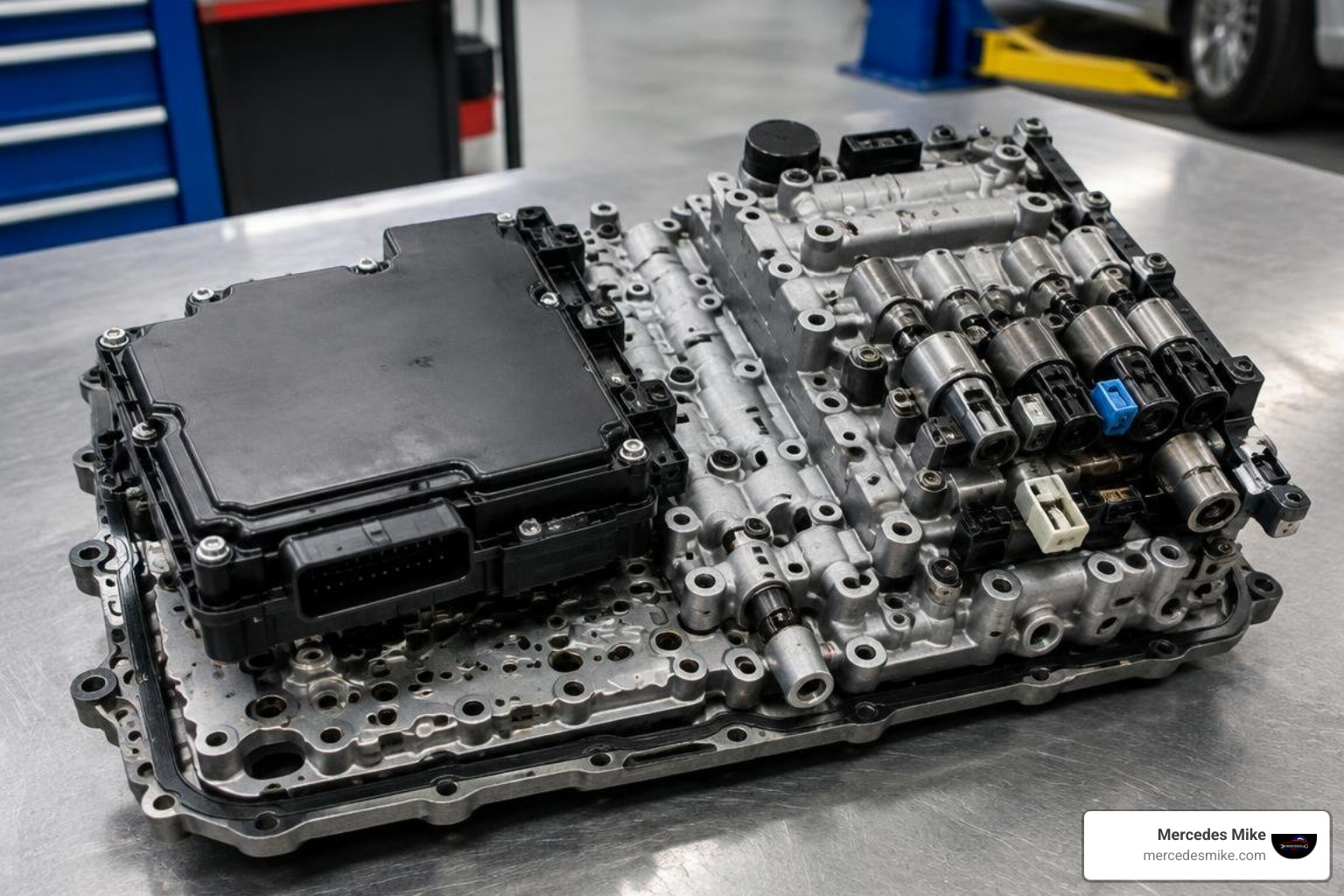
The 722.9 Mechatronic unit (the combination of the hydraulic valve body and the electronic conductor plate) is vulnerable to micro-debris. When metallic particles circulate through worn fluid, they settle on the magnetic speed sensors, causing electrical faults and gear position errors.
Replacing a failed conductor plate or complete valve body assembly requires specialized component programming and module coding. If internal clutches overheat and burn out, a complete transmission replacement or rebuild is often required.
Preventative fluid and filter flushes cost a fraction of what you would pay for major mechanical repairs. For a comprehensive financial breakdown of repair versus maintenance pathways, read our analysis on how much to repair mercedes transmission alongside our complete guide on mercedes maintenance cost.
Frequently Asked Questions About 7G-Tronic Maintenance
Can I mix red and blue Mercedes transmission fluid?
No. MB 236.14 (red) and MB 236.15 (blue) fluids have different base viscosities and friction profiles. Mixing them alters operating hydraulic pressures, causing clutch slippage, delayed gear shifts, and valve body faults. If the wrong fluid is added, you must fully flush the transmission, torque converter, and cooler lines.
How do technicians check 7G-Tronic fluid levels without a dipstick?
The 722.9 uses an overflow standpipe located in the oil pan rather than an under-hood dipstick tube:
The vehicle is placed on a level lift and fresh fluid is pumped in through the pan drain port.
A diagnostic scan tool monitors live transmission control module (TCM) temperature.
Once the fluid reaches exactly 45°C (113°F) with the engine idling in Park, the fill adapter is removed.
Excess fluid drains over the internal standpipe. When the flow slows to a light trickle, the drain plug is torqued down, setting the correct level.
Was the 7G-Tronic transmission ever truly "sealed for life"?
Early marketing materials claimed these transmissions were "filled for life," but Mercedes-Benz reversed this policy after observing premature valve body wear, clutch degradation, and speed sensor failures. Regular fluid and filter changes are required across all 7G-Tronic and 7G-Tronic Plus models.
Conclusion
Keeping your Mercedes 722.9 transmission shifting smoothly comes down to clean fluid, the right factory-approved specifications, and timely servicing. Sticking to a reliable service interval—roughly every 39,000 miles for early 7G-Tronic gearboxes and 40,000 to 50,000 miles for 7G-Tronic Plus models—protects your valve body, preserves clutch life, and helps avoid expensive driveline repairs.
If you are in Pompano Beach, Deerfield Beach FL, or the wider South Florida area, our team at Mercedes Mike is ready to help. Our technicians use factory diagnostic equipment, OEM filters, and Mercedes-approved fluids to keep your vehicle operating at peak performance. Schedule your expert Mercedes transmission service with us today on N Dixie Hwy.