
Cool Breeze or Empty Wallet: Is Your Condenser Repair Quote Fair?
What Does It Cost to Replace a Car AC Condenser in 2026?
The cost to replace a car AC condenser is typically $700 to $1,500 installed in 2026. For a German luxury car, the bill may reach $1,200 to $2,800, depending on the part, access, labor, and refrigerant. A national estimate puts the average at about $841 to $988, but your written quote should also show the cost of testing, seals, and recharging the system.
Warm air alone does not prove the condenser has failed. A leak test can help confirm whether it needs replacement or whether another AC part is at fault. I’m Mike Ibrahim, and I’ll walk you through what makes a condenser quote fair.

Average Breakdown: What Is the Cost to Replace a Car AC Condenser?
When facing a sudden loss of cooling inside your cabin, evaluating repair quotes requires understanding the going rates. In 2026, standard industry benchmarks put the average automotive AC condenser replacement bill between $841 and $988 across all vehicle makes. However, real-world shop invoices range anywhere from $700 to $1,500 for domestic and Asian passenger vehicles, extending up to $2,800 for high-end European platforms.
The complete repair requires more than just bolting in a new aluminum radiator-like grid. It involves reclaiming existing gas, dismantling front-end body panels, exchanging vital secondary seals and filters, running a deep vacuum cycle, and injecting fresh refrigerant and lubricating oil.
According to 2026 automotive air conditioning cost data, these figures reflect modern diagnostic routines and modern refrigerant pricing. The table below outlines how pricing shifts depending on the vehicle class and the type of repair facility you choose:
Vehicle Class | Independent Specialist | Dealership Service Dept | DIY (Parts & Equipment Rental Only) |
|---|---|---|---|
Compact / Economy Sedan | $650 – $950 | $900 – $1,300 | $250 – $450 |
Mid-Size SUV / Light Truck | $750 – $1,200 | $1,000 – $1,600 | $300 – $550 |
German Luxury (Mercedes / BMW / Audi / Porsche) | $1,200 – $2,100 | $1,800 – $2,800 | $550 – $900 |
Parts vs. Labor: Where Your Money Goes
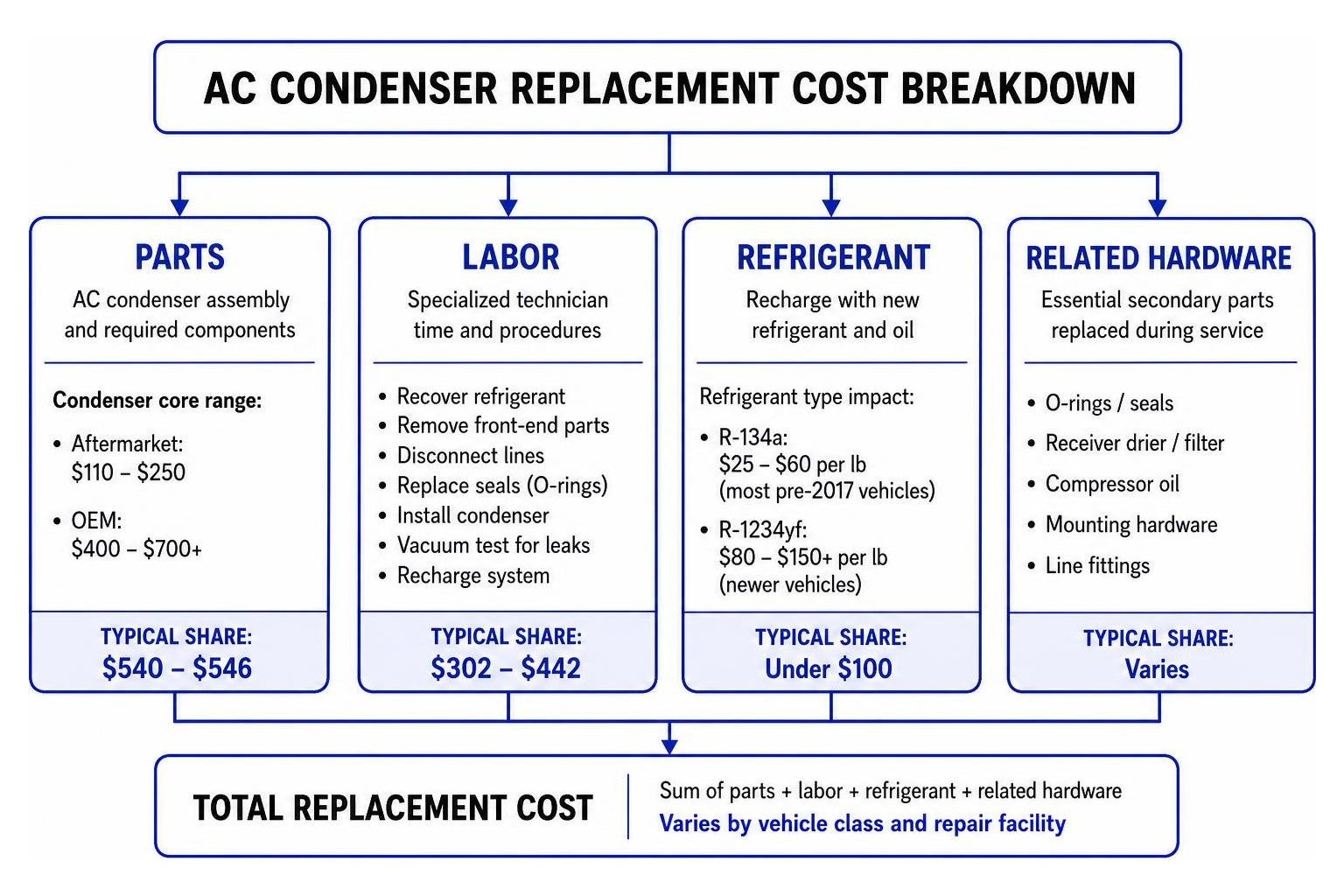
An itemized quote generally divides expenses into hardware and mechanical labor. Industry data shows parts typically average between $540 and $546 for OEM-spec assemblies, while specialized shop labor accounts for $302 to $442.
The standalone condenser core ranges dramatically based on sourcing. Aftermarket units for high-volume commuter models run between $110 and $250, whereas genuine OEM heat exchangers range from $400 to over $700. Baseline mechanical figures from the Kelley Blue Book AC repair pricing guide illustrate that overall AC servicing often starts around standard bench minimums, but replacing physical hardware drives up billable time.
A standard installation requires between 2 and 5 labor hours. The technician must safely recover any remaining pressurized refrigerant, disconnect fluid lines, swap delicate O-rings, mount the core, test for leaks under vacuum, and meter out an exact gas recharge.
Vehicle Tier Impact: Economy Cars vs. Luxury European Models
Why does replacing a condenser on a Mercedes-Benz E-Class or Porsche Macan cost significantly more than on a standard domestic sedan? The answer lies in engineering complexity, packaging constraints, and tightly packed front cooling modules.
In compact economy vehicles, unbolting the upper radiator support often creates enough clearance to slide out the condenser in under two hours. In contrast, modern German luxury platforms integrate complex cooling stacks where the AC condenser, engine radiator, transmission cooler, turbo intercooler, and active aero shutters are tightly sandwiched together. Accessing the condenser requires full removal of the front bumper cover, parking sensor harnesses, adaptive cruise control radar sensors, and headlight assemblies. For an extensive look at how these engineering hurdles influence estimates, explore our ac condenser repair cost guide.
Key Factors Influencing Your Replacement Estimate
Several variables dictate the final total on your repair order. Regional labor rates, seasonal demand spikes during peak summer months, and underlying component wear all shift the baseline estimate. If a seized compressor has scattered metallic shavings throughout the AC lines, addressing the cost to fix an ac compressor alongside the condenser becomes necessary to prevent immediate repeat failures.
How Refrigerant Selection Affects the Replace AC Condenser Cost for a Car
One of the largest hidden drivers of the final replace ac condenser cost car owners encounter is the chemical refrigerant running through their system. The automotive industry transitioned away from legacy compounds to environmentally friendly alternatives, creating a substantial pricing gap:
R-134a: Standard on most pre-2017 passenger vehicles. It costs shops approximately $25 to $60 per pound, keeping the refrigerant portion of your bill under $100 for a standard charge.
R-1234yf: Mandated for newer vehicles due to its ultra-low global warming potential. This specialized refrigerant costs $90 to $180 per pound wholesale. An empty system requiring a complete recharge can easily add $200 to $400 in refrigerant charges alone.
Recharging these modern circuits requires certified technicians operating dedicated, EPA-compliant recovery machines to prevent cross-contamination and ensure proper line pressures. You can discover more about complete system charging requirements in our guide to air conditioning recharge procedures.
Why Accompanying Parts Must Be Replaced
A quality repair involves replacing several related components to protect the sealed system and validate parts warranties:
Receiver-Drier / Desiccant Bag: This component absorbs internal moisture and filters small particles. Once exposed to ambient air during a condenser swap, the desiccant material quickly becomes saturated and must be renewed.
Expansion Valve / Orifice Tube: Tiny internal metering ports can capture micro-debris, leading to restricted refrigerant flow and erratic cooling.
HNBR Rubber O-Rings: High-pressure connections require fresh, oil-lubricated seals to eliminate slow leaks at tube joints.
PAG Lubricating Oil: A precise amount of fresh compressor oil must be added back into the system to replenish what was trapped inside the discarded condenser core.
Warning Signs Your AC Condenser Is Damaged or Blocked
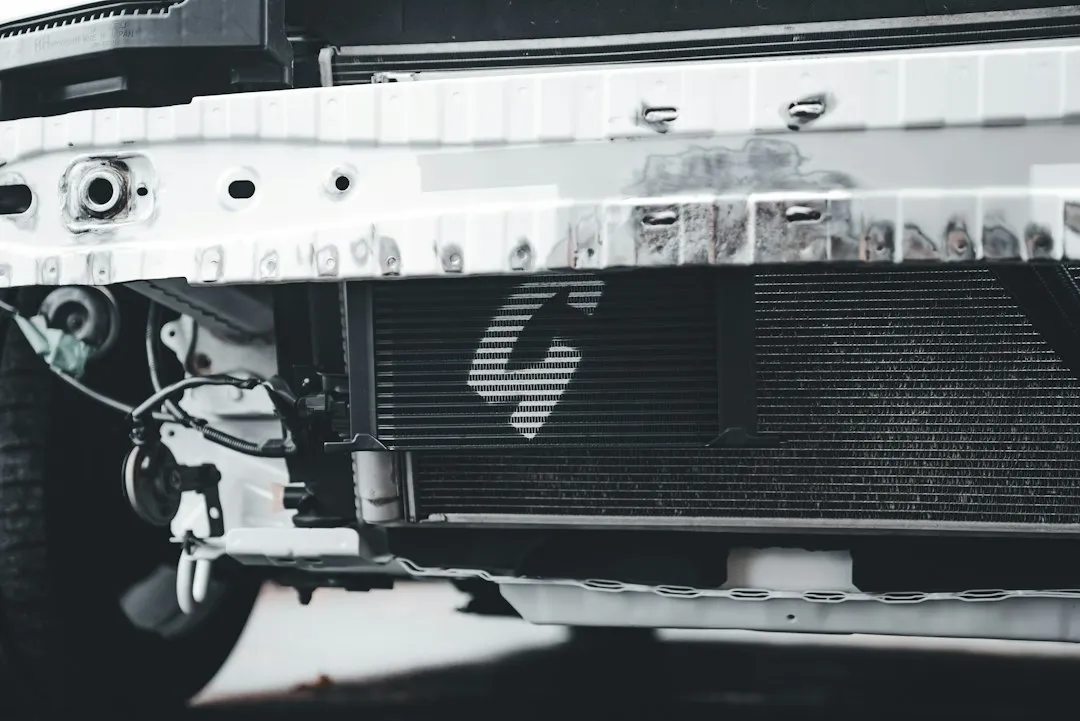
The AC condenser sits at the very front of your vehicle, directly behind the main grille. While this location provides the high-speed ambient airflow required to cool superheated refrigerant gas into a high-pressure liquid, it also leaves the fragile aluminum fins vulnerable to road hazards.
Refrigerant Leaks and Warm Air at Idle
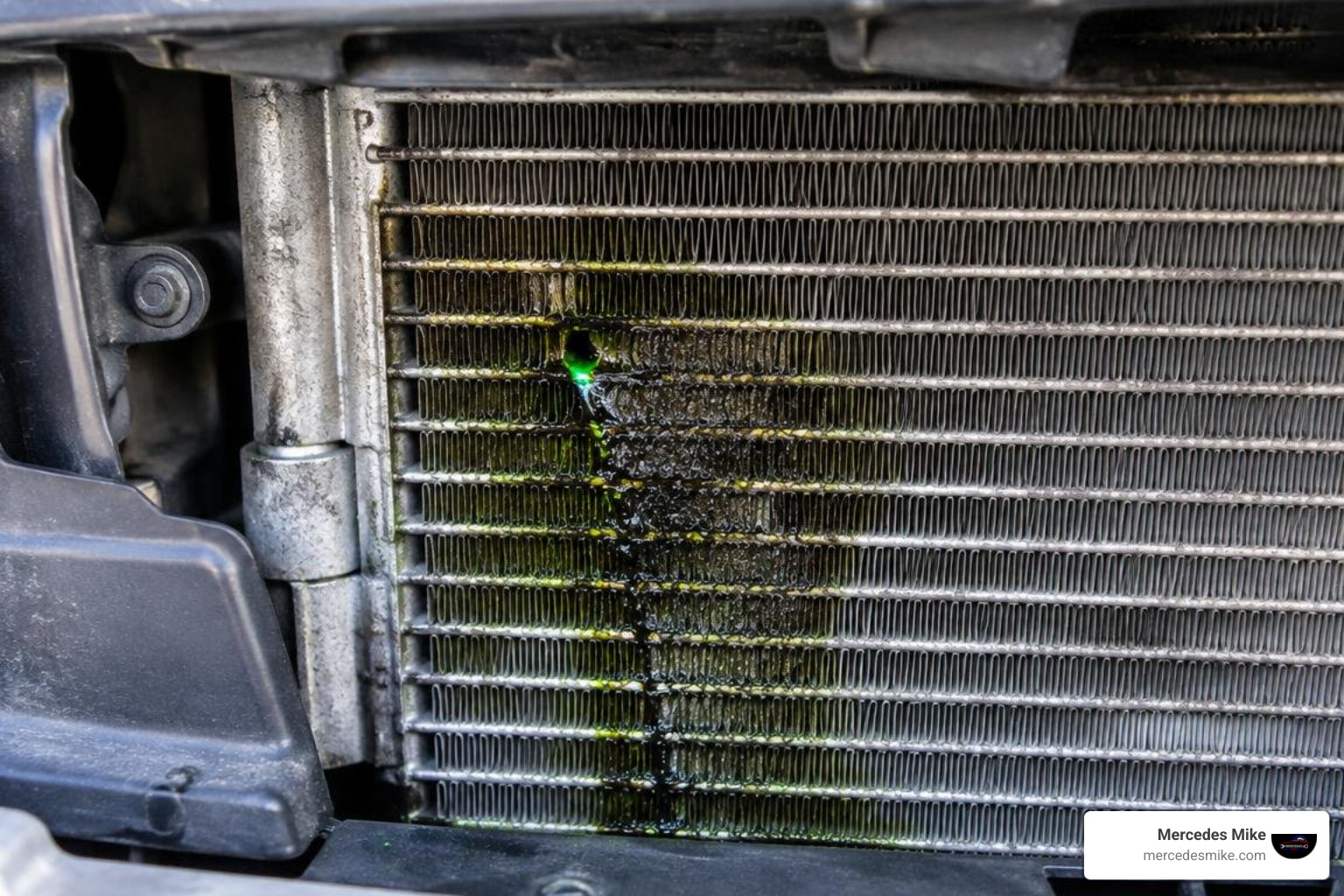
Because the condenser faces open highway traffic, kicked-up gravel, road salt, and debris can puncture its thin tubes. When refrigerant escapes, it carries atomized PAG lubricating oil with it, creating a dark, greasy film across the exterior fins that attracts road dirt.
If you add UV dye during routine refrigerant leak repair diagnostics, leaks illuminate brightly under ultraviolet light. The immediate passenger symptom is weak cooling that deteriorates into completely warm air when sitting at red lights or idling in traffic.
Clogged Fins and Engine Overheating
The condenser sheds heat absorbed from your car cabin directly into the air passing through the engine bay. If dust, leaves, insects, or bent fins block more than 30% of this surface area, heat rejection stalls out.
Because the engine radiator sits directly behind the condenser, a blocked AC core traps scorching air against the engine cooling system. Insights from vehicle overheating diagnostics research emphasize that running your air conditioning with a fouled condenser forces the engine cooling fan into high overdrive and can rapidly trigger engine overheating, putting cylinder head gaskets at serious risk.
Professional Replacement vs. DIY Considerations
Attempting an at-home repair often seems like an attractive way to bypass labor fees. However, automotive air conditioning circuits operate under severe pressures exceeding 250 PSI and are governed by strict environmental mandates.

Professional vs. DIY: True Replace AC Condenser Cost for a Car
Working on an AC system at home requires specialized equipment that most DIYers do not own:
EPA Regulations and Recovery: Federal law under Section 609 of the Clean Air Act prohibits venting refrigerant into the open atmosphere. A licensed recovery machine and storage cylinder are required to capture the gas safely.
Vacuum Micron Gauges and Pumps: Installing a part leaves moisture and non-condensable ambient air inside the pipes. A commercial two-stage vacuum pump must pull the system down to at least 500 microns and hold that vacuum for 30 to 45 minutes to boil off ambient moisture and confirm zero line leaks before charging.
Safety Hazards: Liquid refrigerant escaping from a pressurized fitting boils instantly at sub-zero temperatures, presenting a severe risk of chemical skin burns and eye injuries.
Warranty Protections: Most parts manufacturers automatically void condenser replacement warranties unless an invoice proves the receiver-drier was replaced and the system was pulled under professional vacuum.
When accounting for the cost of buying manifold gauges, safety fittings, a vacuum pump, and recovery gear, the real DIY replace ac condenser cost car owners incur often matches or exceeds an independent specialist's labor fee.
Repair-to-Value Math: When to Fix vs. When to Sell
If you own an older daily driver, spending $1,000 or more on an HVAC overhaul requires weighing the repair against the car's current market worth. A practical rule of thumb is the 15-to-25% threshold:
Under 15% of Vehicle Value: If the repair costs less than 15% of the vehicle's private-party value, completing the work makes clear financial sense.
Over 25% of Vehicle Value: If an extensive $1,800 repair bill lands on a vehicle worth only $3,500, reevaluating makes sense.
However, trying to sell a vehicle with broken air conditioning leads to steep discounts. Prospective private buyers and trade-in appraisers routinely deduct $1,500 to $2,500 from an offer when the AC blows hot air, fearing widespread component failure. Fixing the leak beforehand almost always preserves more resale equity than selling as-is.
Frequently Asked Questions About Car AC Condenser Replacement
How long does a condenser replacement typically take?
A complete condenser replacement generally takes between 2 and 4 hours of active mechanical labor. The process requires removing front grilles or bumper assemblies, reclaiming the old gas, bolting in the new core with fresh lubricated seals, running a continuous 30-to-45-minute vacuum boil-off cycle, and precision-charging the circuit to factory weight specifications.
Why does the AC blow warm when idling but cool down at highway speeds?
When your vehicle is parked or idling, ambient air does not naturally rush through the front grille. The system relies entirely on the electric radiator/condenser cooling fan to pull air across the core. If the condenser fins are partially clogged with dirt or the fan motor is weak, high-side system pressures climb rapidly, preventing heat exchange until highway speeds force cooler outside air through the front bumper.
What warranty should come with a new condenser installation?
Reputable independent repair facilities and dealerships typically provide a 12-month / 12,000-mile to 24-month / 24,000-mile warranty covering both parts and labor. To maintain warranty coverage, repair shops must replace the receiver-drier or desiccant cartridge and verify proper vacuum retention during installation.
Conclusion
A leaking or damaged AC condenser quickly turns any commute into an unbearable ordeal. A fair replacement estimate should clearly break down the cost of the condenser core, accompanying receiver-drier seals, system evacuation, and precision refrigerant recharging. Always demand a transparent, itemized written estimate backed by nitrogen pressure or electronic leak testing before authorizing work.
For drivers in Pompano Beach and surrounding South Florida communities, dealing with high heat and ocean salt air demands precise HVAC care. At Mercedes Mike, our decades-experienced technicians specialize in premier service for Mercedes-Benz, BMW, Audi, and Porsche vehicles. Utilizing the latest diagnostic equipment, recovery systems, and OEM-grade components, we restore your vehicle's factory cooling performance reliably. Schedule your ac condenser repair with our certified specialists today and get back to enjoying a crisp, cool cabin.