Stop Ignoring Your Dashboard Service Reminders Today

Why Following Service Intervals Protects Longevity and Resale Value
A complete vehicle maintenance schedule typically begins with engine oil and filter replacement plus tire rotation every 5,000 to 10,000 miles. At 30,000 miles, plan for engine and cabin air filters, a brake fluid flush, and suspension and brake inspections. At 60,000 miles, transmission fluid, drive belts, and cooling system components require attention, while the 100,000-mile milestone usually calls for spark plugs, coolant service, and timing belt replacement on engines so equipped. Following these intervals prevents minor wear from becoming major mechanical failure.
Industry data indicates that nine in ten drivers believe they take proper care of their automobiles, yet only 41 percent actually follow the manufacturer's recommended service schedule. Modern vehicles often run quietly even when lubricants break down and filters clog, creating a false sense of security until a mechanical failure occurs.
Neglecting regular maintenance quickly turns minor upkeep into major repairs. Routine motor oil changes cost relatively little, whereas replacing a sludge-damaged turbocharged engine can easily cost thousands. Consistently adhering to a structured service routine bridges the gap between scheduled maintenance vs preventive maintenance, ensuring routine wear parts are replaced before they cause catastrophic damage.
Proper service intervals also protect factory warranty coverage. Most new vehicles include a 36-month or 36,000-mile bumper-to-bumper warranty alongside powertrain coverage lasting 60 months or 60,000 miles. However, as outlined in standard manufacturer documentation such as the Toyota Warranty & Maintenance Guide, claims for component failures caused by improper lubrication or neglected servicing can be legally denied.
Maintaining complete, timestamped service records also directly influences vehicle resale value. Prospective buyers and appraisal professionals place higher values on vehicles that demonstrate continuous, documented care from certified technicians.
Understanding the Core Vehicle Maintenance Schedule: Key Mileage Milestones
A structured maintenance framework outlines when specific inspections, fluid exchanges, and component replacements must occur throughout a vehicle's operating lifecycle.
Service Interval | Primary Maintenance Tasks | Key Components Inspected | System Objective |
|---|---|---|---|
5,000 – 10,000 Miles | Engine oil & filter replacement, tire rotation | Brake pad thickness, tire pressures, exterior lighting, fluid levels | Maintain lubrication, ensure uniform tire wear, catch early leaks |
30,000 Miles | Engine air filter, cabin microfilter, brake fluid flush | Steering linkage, suspension joints, exhaust system, battery terminals | Restore airflow, remove hygroscopic brake moisture, clean electrical connections |
60,000 Miles | Transmission fluid drain & fill, spark plugs (select models), drive belts | Cooling system hoses, fuel lines, drive axle boots, brake rotors | Prevent gearbox wear, sustain combustion efficiency, avoid belt snaps |
100,000 Miles | Spark plugs (long-life), coolant flush, timing belt & water pump (if equipped) | Oxygen sensors, suspension bushings, engine mounts, catalytic converter | Prevent severe overheating, avoid valve-to-piston contact, preserve emissions |
Adhering to these milestones through factory scheduled maintenance prevents minor wear from compounding into expensive driveline faults.
Routine Weekly and Monthly Checkpoints
Between scheduled shop visits, simple owner inspections help catch issues before they turn into dashboard warnings:
Tire Pressure (Cold PSI): Check monthly using a dedicated digital gauge when tires have rested for at least three hours. Proper inflation prevents premature edge wear and preserves fuel efficiency.
Engine Oil Level: Inspect the dipstick or digital cluster reading monthly on level ground to catch early oil consumption.
Windshield Washer Fluid: Top off the reservoir to maintain clear visibility through seasonal debris and road grime.
Exterior Lighting: Verify operation of low beams, high beams, turn indicators, reverse lamps, and brake lights.
Brake Fluid Clarity: Ensure reservoir fluid appears translucent amber rather than dark, oxidized brown.
Wiper Blade Condition: Inspect rubber squeegees for tears, chattering, or streaking across the glass.
Intermediate Milestones: 30,000 to 60,000 Miles
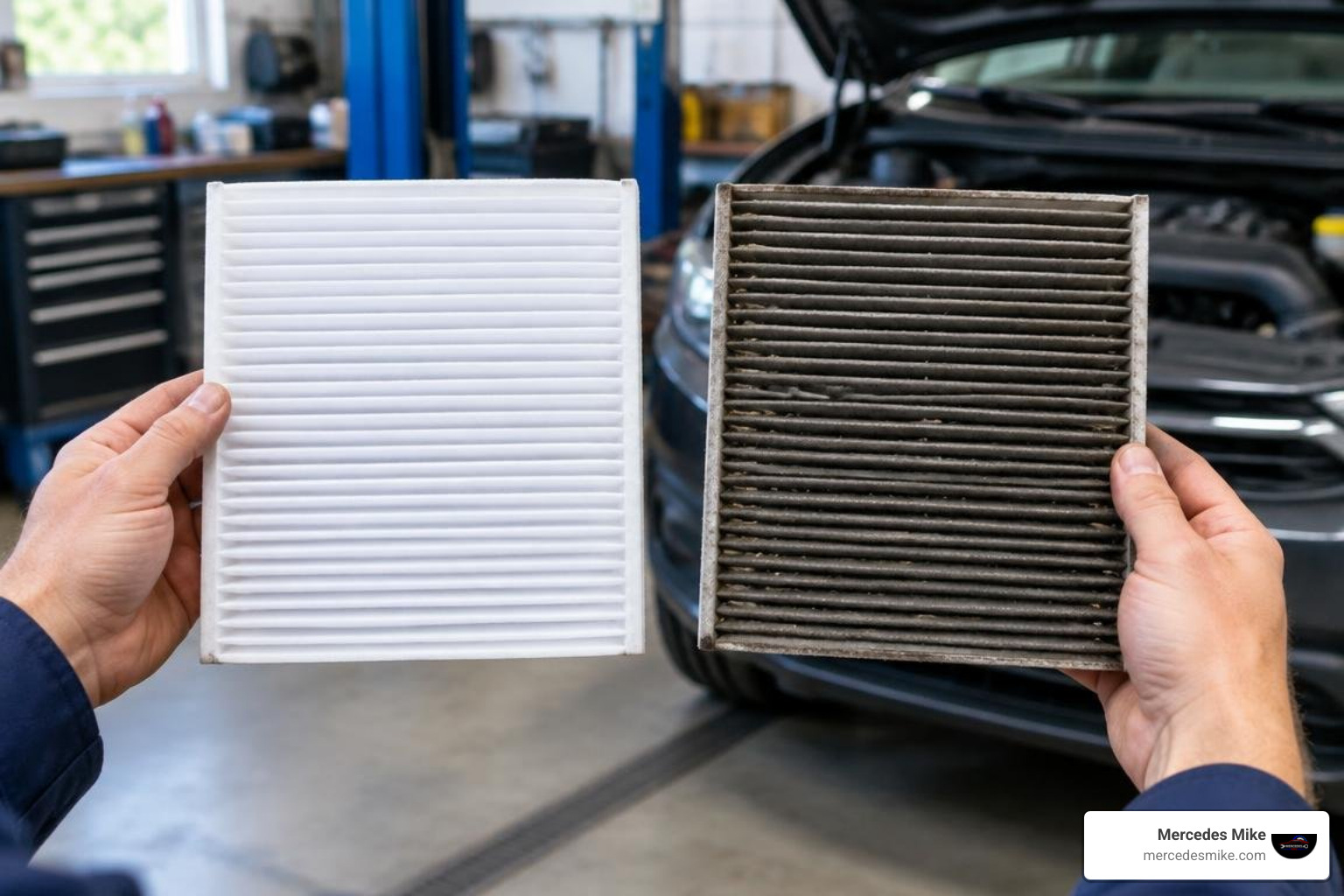
Once an odometer passes 30,000 miles, environmental contamination and thermal stress require targeted replacements. Both engine air filters and cabin microfilters become restricted by road dust and pollen, reducing HVAC output and straining fuel-trim adaptations.
Brake fluid also requires attention at this stage. Standard polyglycol-based fluids (such as DOT 4) are hygroscopic, naturally absorbing ambient moisture through rubber flex hoses and reservoir vents. Once moisture content climbs, the fluid's boiling point drops significantly, leading to a spongy brake pedal feel under sustained braking.
Between 30,000 and 60,000 miles, automatic transmission fluid and differentials undergo initial thermal degradation. Completing a pan drain, filter replacement, and fluid refill cleans out suspended metallic particles, protecting internal hydraulic valve bodies. Drivers planning their long-term ownership budget should factor in the Mercedes-Benz 60k service cost to manage these essential driveline services.
Major Service Milestones: 90,000 to 150,000+ Miles
Approaching the six-figure mileage mark marks a critical transition point. Platinum and iridium spark plugs wear down their center electrodes over time, increasing the gap and straining ignition coils. Replacing spark plugs restores factory cold-start efficiency and prevents engine misfires.
If an engine utilizes a rubber timing belt rather than an internal steel timing chain, replacement between 60,000 and 100,000 miles is vital. On interference engines, timing belt failure causes the camshaft to stop while the crankshaft spins, leading to immediate valve-to-piston collisions that can destroy the cylinder head. Technicians routinely replace the engine water pump, belt tensioner pulleys, and front crankshaft seals during this service because access requires removing the same engine covers.
Cooling systems also require a thorough flush. Engine coolant loses its anti-corrosive additive package over time, turning acidic and attacking aluminum radiator cores, heater cores, and head gaskets. Our 100,000-mile maintenance guide details the complete inspection process for high-mileage platforms, including oxygen sensors, control arm bushings, and driveline mounts.
Normal vs. Severe Operating Conditions
Automotive manufacturers split their service intervals into "Normal" and "Severe" (sometimes labeled "Schedule 1" and "Schedule 2") operating tracks, as documented in the Ford Scheduled Maintenance Information. Most drivers assume their commute falls under normal conditions, but common driving habits often qualify as severe service:
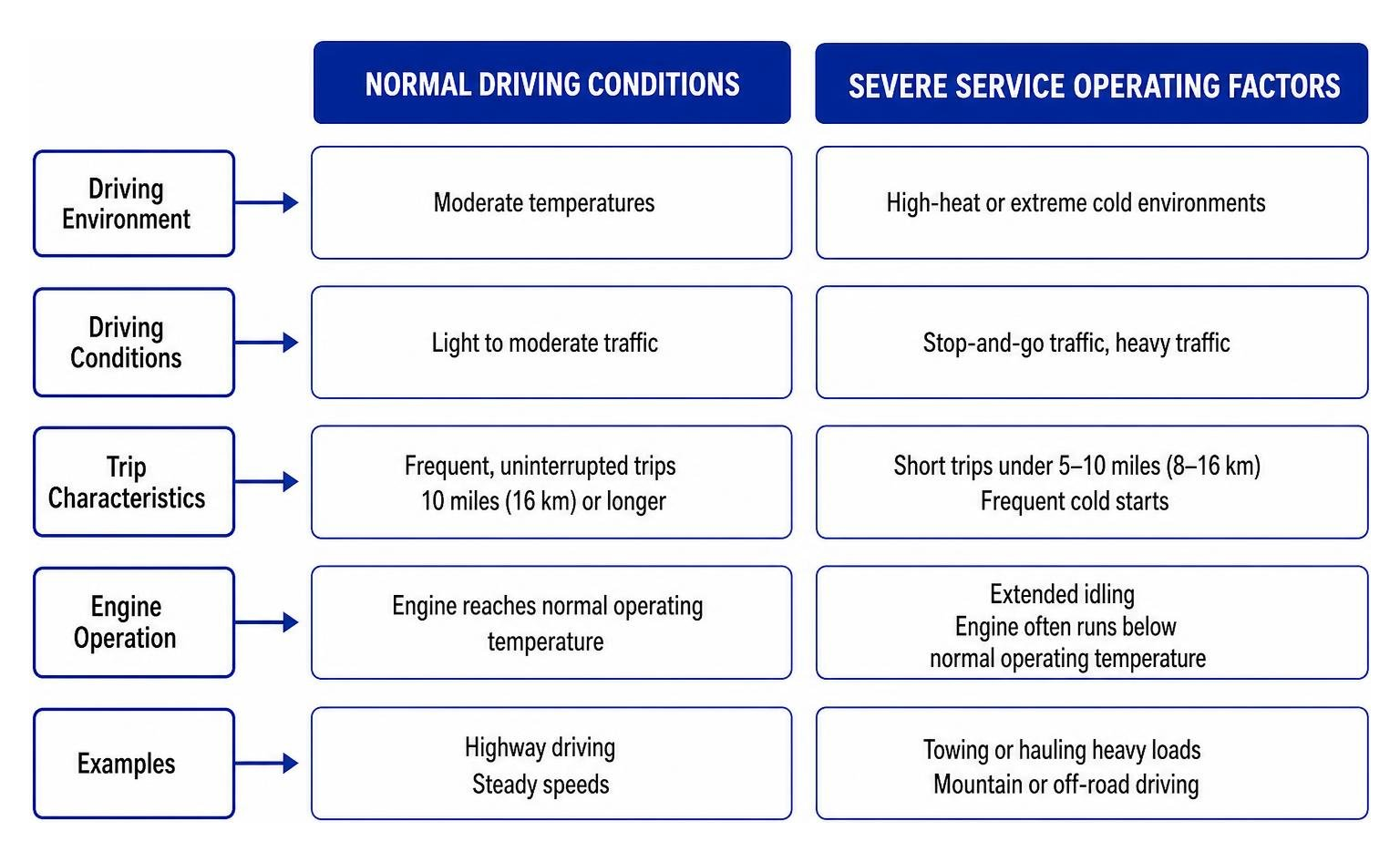
How Driving Habits Impact Your Vehicle Maintenance Schedule
Short commutes under five to ten miles rarely allow engine oil to reach its optimal operating temperature (roughly 212°F / 100°C). Consequently, fuel blow-by and crankcase condensation fail to evaporate, diluting engine oil, breaking down viscosity, and forming black engine sludge.
In high-heat subtropical environments and stop-and-go coastal traffic, severe-service intervals are critical. Extended idling in heavy traffic accelerates thermal oxidation in automatic transmission fluids and power steering hydraulics, requiring shortened fluid change intervals. Precision sports platforms demand similar adjustments; following a tailored Porsche service schedule accounts for track use, aggressive heat cycles, and high-RPM engine stresses.
The Most Commonly Neglected Automotive Components
While most motorists remember regular engine oil changes, several secondary components are often overlooked:
Cabin Air Filters: Traps dust, mold spores, and airborne particulates before they enter the interior. When clogged, cabin air filters restrict blower motor airflow, strain HVAC components, and cause persistent interior odors.
Brake Fluid: Moisture-laden fluid corrodes internal anti-lock brake system (ABS) valves and caliper pistons from the inside out, significantly lowering the fluid's boiling point.
Transmission Fluid: Many owners mistakenly believe transmission fluids last forever. In reality, thermal breakdown degrades friction modifiers, leading to rough shifts and clutch pack slipping.
Engine Coolant Additives: Even if coolant tests fine on a hydrometer for freeze protection, its corrosion-inhibiting chemical package depletes, allowing electrochemical degradation to pit internal metal passages.
Drive Belt Tensioners: Mechanical spring dampers on serpentine belt tensioners weaken over time, causing belt slippage, charging system drops, or accessory drive failure.
Customizing Service for Modern Powertrains and Luxury Platforms
Modern engineering requires tailored maintenance approaches that vary by powertrain and brand:
Direct-Injection Gasoline Engines: Because fuel is sprayed straight into combustion chambers rather than across intake runners, intake valves do not benefit from fuel detergents. Over time, crankcase vapors form carbon deposits on intake valve stems, requiring chemical induction cleanings or walnut-shell blasting.
Hybrid & Electric Platforms: High-voltage systems require dedicated inverter cooling loops that use non-conductive coolants, along with regular diagnostic scans of battery cell resistance and charge capacity.
German Luxury Vehicles: Brands like Mercedes-Benz, BMW, Audi, and Porsche operate with tighter mechanical clearances and complex electronic control modules. Following a dedicated Mercedes-Benz service schedule or an Audi A4 service schedule ensures service conforms to strict factory tolerances, approved lubricant standards, and dedicated system health scans.
How to Find the Manufacturer Vehicle Maintenance Schedule for Your Car
Finding your specific maintenance requirements involves several reliable resources:
The Physical Owner's Manual: Review the dedicated warranty and maintenance booklet inside your glove compartment.
Manufacturer Digital Portals: Access the owner portal on the manufacturer's website to view downloadable PDF maintenance schedules by VIN.
Onboard Condition-Based Systems: Modern instrument clusters display service codes (such as Mercedes-Benz Service A/B notifications or BMW Condition Based Service warnings) calculated by sensors monitoring engine run time, rev cycles, operating temperatures, and calendar age.
Updated Industry Frameworks: Reviewing our scheduled maintenance guide for 2026 helps translate on-screen diagnostic service codes into actionable maintenance plans.
Baseline Protocols for Used Cars with Unknown Service History
Acquiring a pre-owned vehicle without verifiable service history requires resetting the maintenance baseline immediately. Rather than guessing the age of internal fluids and wearable parts, complete these foundational baseline tasks:
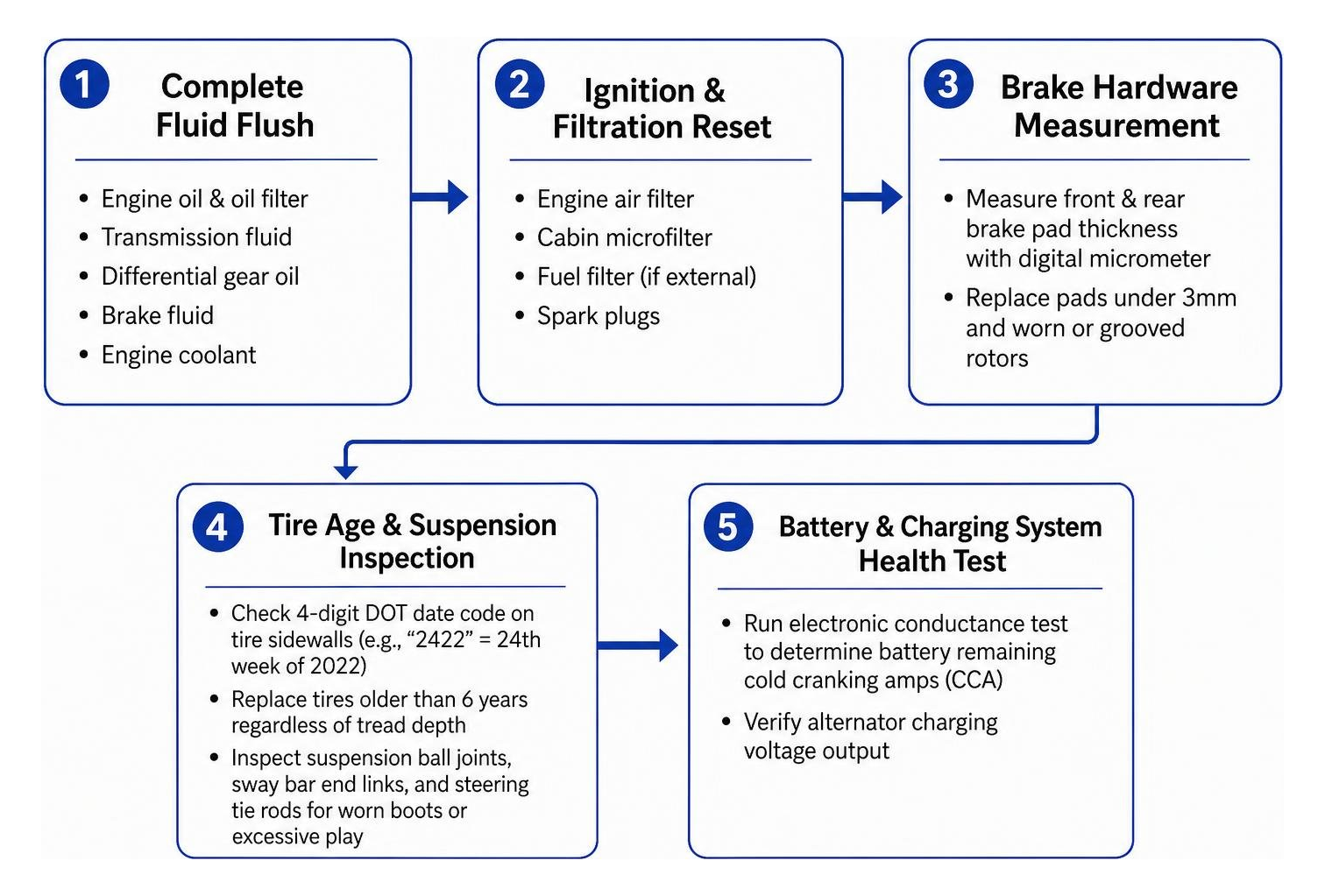
Complete Fluid Flush: Replace engine oil, oil filter, transmission fluid, differential gear oil, brake fluid, and engine coolant.
Ignition & Filtration Reset: Install new engine air filters, cabin microfilters, fuel filters (if external), and spark plugs.
Brake Hardware Measurement: Measure front and rear brake pad friction material with a digital micrometer. Replace pads measuring under 3mm, along with worn or grooved rotors.
Tire Age & Suspension Inspection: Check the 4-digit DOT date code stamped on tire sidewalls (e.g., "2422" indicates production in the 24th week of 2022). Tires older than six years require replacement regardless of remaining tread depth due to dry rotting. Inspect suspension ball joints, sway bar end links, and steering tie rods for worn boots or excessive play.
Battery & Charging System Health Test: Run an electronic conductance test to determine the battery's remaining cold cranking amps (CCA) and verify alternator charging voltage output.
Service Documentation: Record all baseline work, fluid weights, and parts in a dedicated maintenance log or spreadsheet starting from the purchase odometer reading.
Frequently Asked Questions About Vehicle Maintenance
What is the 30-60-90 rule for car maintenance?
The 30-60-90 rule is a straightforward framework that groups maintenance milestones into intervals of 30,000, 60,000, and 90,000 miles:
At 30,000 Miles: Replace air filters, flush the brake fluid, rotate tires, and inspect suspension bushings and brake pads.
At 60,000 Miles: Replace transmission fluid, check cooling system hoses, service drive belts, and inspect the ignition system.
At 90,000 Miles: Replace spark plugs, flush the cooling system, replace the timing belt and water pump (if equipped), and inspect internal emissions hardware like oxygen sensors.
What happens if I miss a scheduled vehicle service?
Missing a scheduled service leads to compounded internal wear, oil oxidation, and abrasive carbon sludge accumulation within valve-train guides, piston rings, and hydraulic passages. Over time, restricted airflow and deteriorated spark plugs reduce fuel economy.
Skipping regular service can also void factory powertrain warranties if a mechanical failure occurs. Documented proof of regular maintenance is essential to protect warranty claims and preserve future resale value.
How do severe service schedules differ from normal schedules?
Severe service schedules generally shorten standard operating intervals by 30 to 50 percent. For instance, an engine oil interval specified at 10,000 miles under normal driving drops to 5,000 miles under severe conditions.
Severe schedules account for short-distance trips under ten miles, frequent stop-and-go driving, high-temperature climates, extended engine idling, dusty roads, and heavy cargo hauling. These conditions subject lubricants and cooling systems to elevated thermal stress, requiring more frequent maintenance.
Conclusion
A consistent vehicle maintenance schedule is the single most effective way to prevent premature mechanical failures, protect factory warranties, and ensure smooth, reliable performance. Catching small fluid leaks, worn suspension joints, and degraded lubricants early saves significant time and money over the lifespan of your vehicle.
Our team at Mercedes Mike brings decades of hands-on expertise, dealership-level diagnostic scan equipment, and high-precision tools to every inspection and repair. Serving Pompano Beach and South Florida drivers, we specialize in comprehensive maintenance for Mercedes-Benz, BMW, Audi, and Porsche platforms.
If your dashboard service reminder is illuminated or your vehicle is approaching a key mileage milestone, don't wait for minor wear to escalate. Contact our team to schedule your professional vehicle service today.